Grey Glacier: The Ice, the Lake and Four Ways to See It
Twenty-eight kilometres of ice off the Southern Patagonian Ice Field, and four completely different ways to stand in front of it. Here is what each one costs you.
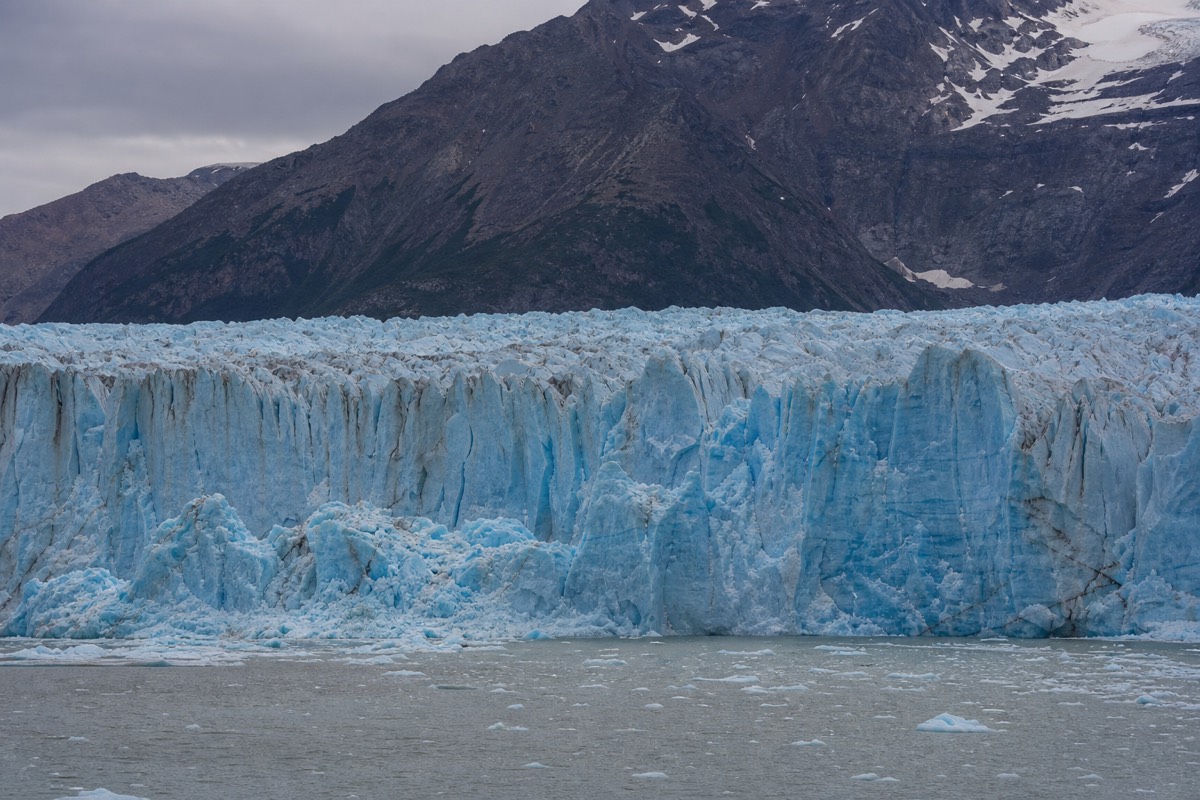
Twenty-eight kilometres long, six kilometres wide, roughly 270 square kilometres of moving ice. Grey Glacier is not a viewpoint, it is a landscape with its own weather. What almost everyone photographs is the last few hundred metres of it, the calving face at the northern end of Lago Grey, and that single frame is what most trip plans are built around. Knowing what sits behind the face is what turns a rushed stop into a day that works.
Four ways to see Grey Glacier, by how long each takes
Durations are the published figures for the activity itself and exclude the drive from Puerto Natales, which is 2 to 3 hours each way.
What is Grey Glacier, and how big is it?
Grey Glacier runs about 28 kilometres long and 6 kilometres wide, covers roughly 270 square kilometres, and flows off the Southern Patagonian Ice Field into Lago Grey in the western half of Torres del Paine. The face standing above the water is commonly given as around 30 metres high. That last figure is the one that misleads people most often.
Thirty metres is a ten-storey building. Seen from a boat a couple of hundred metres out, with nothing human-scaled anywhere in the frame, it reads as a low white wall, and first-timers regularly say the photographs came out smaller than the thing felt. The listing for the scenic cruise we sell describes the face as over 25 metres, which is the conservative version of the same measurement. Both figures are honest. The face is not a flat plane, it changes shape as blocks come away, and any single height is a snapshot.
The scale that actually matters sits upstream and out of sight. Grey is a tongue of the Southern Patagonian Ice Field, one of the largest bodies of ice outside the polar regions, and the glacier you look at from the lake is the drainage spout of something far bigger. That is also why the ice is blue rather than white where it has been compressed and where a fresh face has just been exposed. Old, dense ice absorbs the red end of the spectrum and returns the blue, and the effect is strongest on a flat grey day rather than in bright sun, which is the opposite of what people expect from a glacier photograph.
The glacier splits as it reaches the lake, so the front is not one continuous wall but several fronts separated by rock. From the standard cruise track you generally see more than one of them. On foot from the eastern shore you see the whole tongue in profile instead, which is the better view of the glacier as a glacier and the worse view of the ice as a wall.
| Measure | Figure | What it means on the day |
|---|---|---|
| Length | About 28 km | You see only the terminus, roughly the last kilometre |
| Width | About 6 km | Wider than the lake view suggests, and it splits at the front |
| Area | Roughly 270 km2 | Larger than the whole walkable eastern sector of the park |
| Source | Southern Patagonian Ice Field | The ice is fed from a plateau you cannot see from the lake |
| Face above water | Around 30 m (our cruise listing says over 25 m) | Roughly a ten-storey building, with no scale reference nearby |
| Ice activity season | October to April | Kayaking and ice hiking run in that window only |
Is Grey Glacier retreating, and does that change what you see?
Yes, Grey has been retreating and calving for decades. A large calving event was recorded in 1997, and published research in 2019 documented an underwater terrace at the glacier front. No consistent annual retreat figure exists across published sources, so anyone quoting you a tidy metres-per-year number is guessing. The honest version is more useful anyway.
What retreat means for a visitor is not a slowly shrinking photograph. It means an unstable front. Ice that is thinning and floating calves in ways that grounded ice does not, and the underwater terrace described in that 2019 work is exactly the kind of structure that produces sudden, large releases from below the waterline rather than tidy collapses off the top. That is one reason boats keep a working distance from the face and why nobody is allowed to paddle or land where they please.
It also explains the iceberg supply. The bergs drifting down the lake are not decoration, they are the glacier's recent output, and a season with heavy calving puts more ice on the water for everybody, including the people who never leave the shore. In practice the number of bergs you meet varies week to week and there is no way to check before you book.
We would rather say this plainly than dress it up. The park is not selling you a disappearing landmark on a deadline, and no operator can tell you the glacier will look meaningfully different next year. Over a human lifetime the change is real and documented. Over the length of a holiday it is invisible. Book Grey because you want to see it, not because you have been told it is going.
Why do the icebergs pile up at the south end of Lago Grey?
Ice calves off the glacier at the northern end of Lago Grey and drifts south down the lake until the terminal moraine at the far end stops it. That is why you can stand on a beach beside house-sized icebergs without walking anywhere near the glacier itself, and it is the single most underrated free thing in the park.
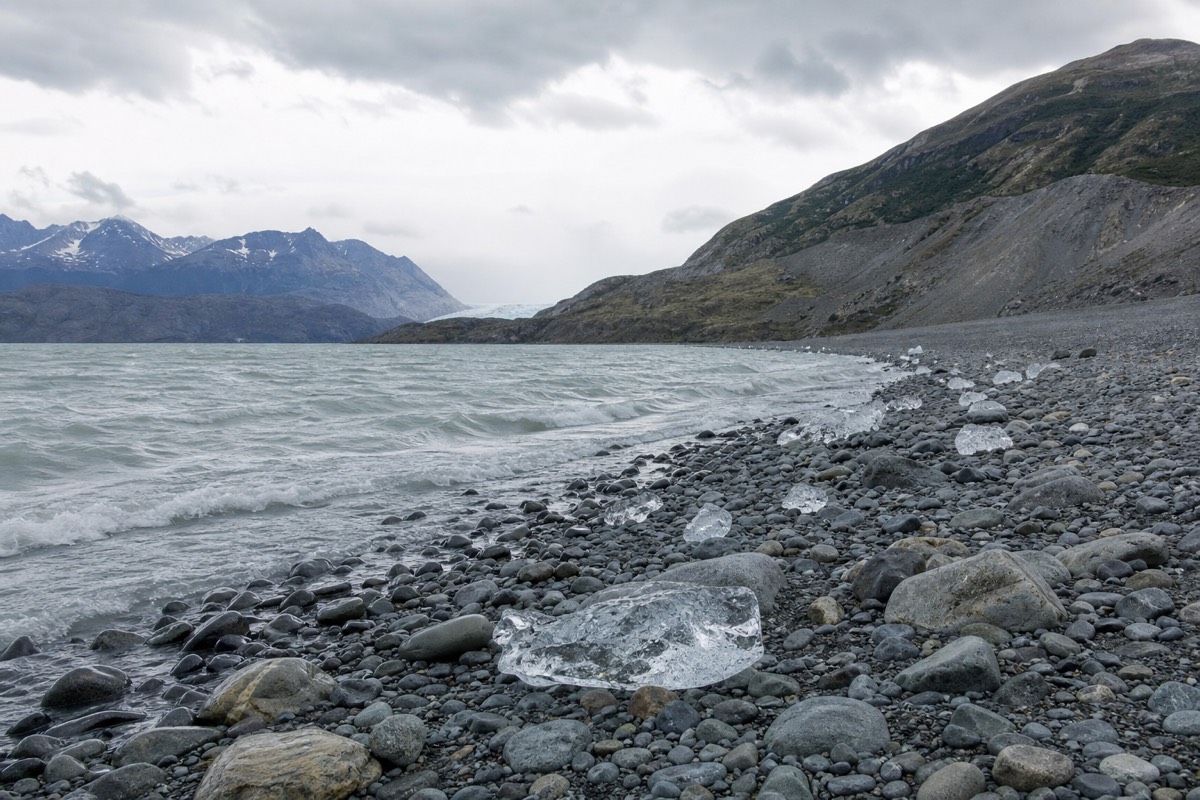
The mechanism is simple. A moraine is the ridge of rock and debris a glacier bulldozes ahead of itself and leaves behind when it pulls back. Lago Grey is dammed at its southern end by exactly that ridge, the water shallows there, and floating ice grounds out before it can go any further. Wind pushes the bergs down the lake, the moraine catches them, and they sit there melting into shapes that look sculpted.
Reaching them takes about an hour. The Lago Grey beach walk from the Guardería Grey ranger post is roughly 2 kilometres out and back with about 50 metres of ascent, along a spit of grey sand and glacial silt that gives the lake its name. On a still morning the bergs are mirrored. On a windy afternoon the same beach is a sandblasting machine and the whitecaps make the far shore invisible.
The beach is also where the scenic cruise leaves from, which makes it the one place in the park where the free version and the paid version of the same experience sit side by side. If the sailing is cancelled by wind, and sailings are cancelled by wind regularly, you can still walk out and stand next to the ice. It is a genuinely good consolation prize and worth knowing about before you commit to the drive.
Can I take a boat trip to the Grey Glacier?
Yes. A three-hour scenic cruise sails from the Hotel Lago Grey pier up the lake to the glacier front and back, currently published at $120. Roughly the first hour is lake and mountain scenery, then the ice. The boat has an indoor cabin and an outdoor deck, and a pisco sour is served on board. It is the way most people see Grey.
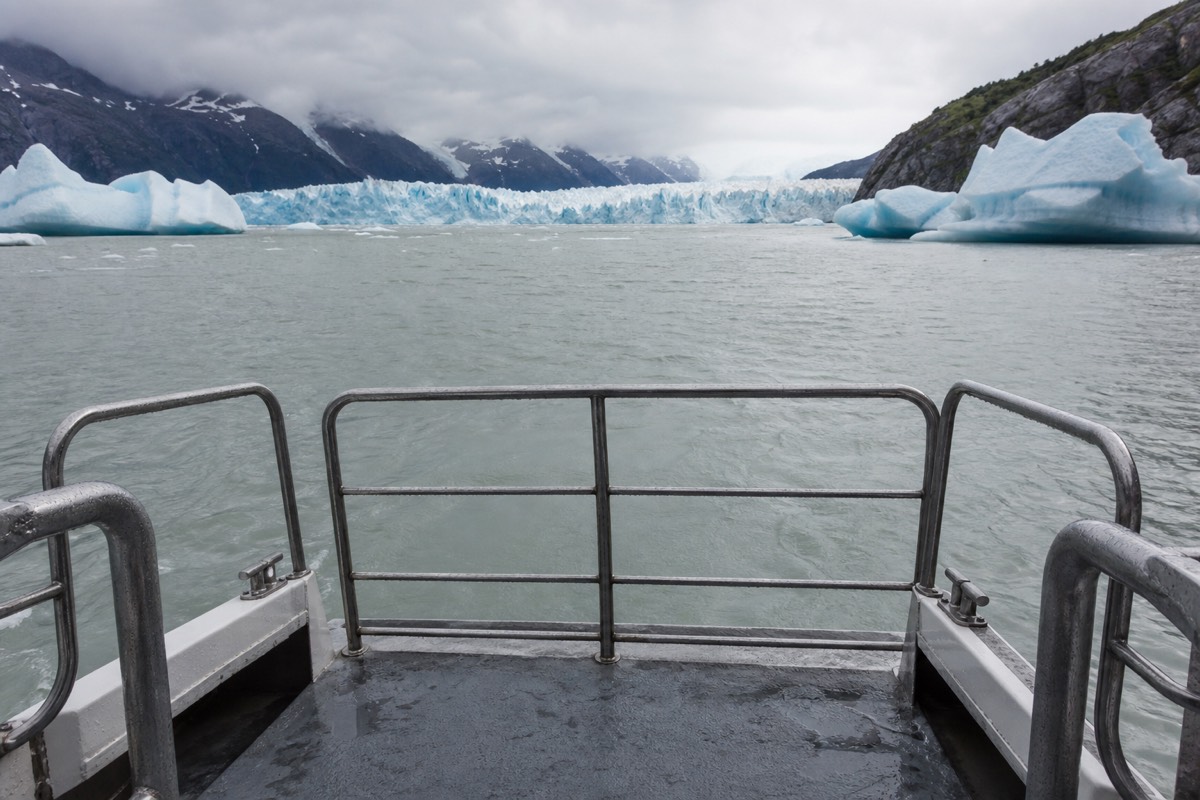
The shape of the trip matters more than the duration. You are not sailing for three hours next to a glacier, you are sailing for about an hour up a long lake threading between icebergs, spending your time at the front, then coming back. People who understand that get the pacing right and stay warm for the part that counts. People who expect the ice immediately spend the first hour indoors and then discover the deck is where the trip actually happens.
Dress for the deck, not for the cabin. The air coming off a glacier front is colder than the air anywhere else on the lake, the boat generates its own wind, and the difference between a good hour and a miserable one is a windproof layer, a hat and gloves. This is true in January. The cabin is there for the transit and for the people who have had enough.
the three-hour Grey Glacier scenic cruise is the product we sell for this, and it has been booked 2,715 times with a 4.4 rating on its listing. If you want the operator's own vessel and pier details, the Lago Grey boat operator publishes its schedule. Wind is the thing to plan around: sailings are cancelled outright when the lake gets up, and there is no way to know more than a few hours ahead.
The other thing worth understanding is the drive. The pier sits in the western part of the park, which is a long way from the Laguna Amarga entrance that most buses use, so a cruise is rarely a bolt-on. It is either the anchor of a day or part of a trek. We cover how the internal connections chain together in the park distance and elevation reference.
How do you reach Grey Glacier on foot?
Two ways. From Paine Grande it is 11 kilometres each way to Refugio Grey, about 4 to 4.5 hours in each direction. From Refugio Grey the mirador and the suspension bridges are a 5.6 kilometre round trip with 150 metres of ascent, around 2 hours. Nobody walks to Grey from a car park in an afternoon.
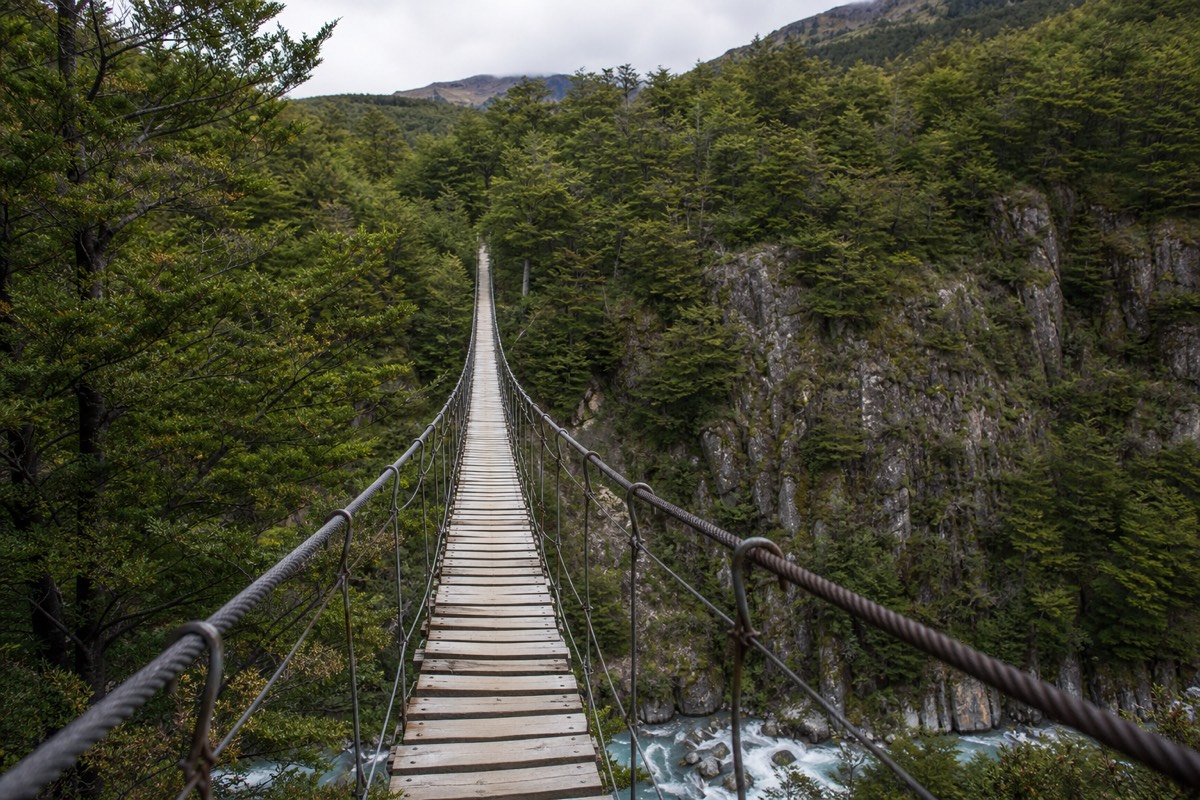
That is the constraint people miss. The western arm of the W is a trekking leg, not a day walk, and the only realistic way to reach Refugio Grey without a multi-day itinerary is the catamaran across Lago Pehoé to Paine Grande followed by a four-hour walk. Which means walking to the glacier is a commitment of at least one full day and usually a night in the sector.
What you get for it is the view the boat cannot give you. The trail climbs the eastern shore with the lake below and the glacier tongue opening out ahead in profile, so you watch it grow for hours rather than arriving at it. Past the refuge, the mirador and the three suspension bridges beyond it put you above the gorge at the glacier's flank. Sources disagree on the naming of all three bridges, so we will say what is reliable: there are three, the longest of them hangs high above the gorge, and they are not for people who dislike heights.
The Grey sector also holds some of the park's quieter short walks, which almost nobody does because they are the wrong side of the park for a day trip. The Ferrier lookout is a short, steep 4 kilometre out and back with 300 metres of ascent that repays the effort with the whole massif in one frame. Pingo valley is a full 21 kilometre day into forest with 750 metres of ascent and very little company.
| On foot in the Grey sector | Distance | Ascent | Typical time |
|---|---|---|---|
| Paine Grande to Refugio Grey | 11 km one way | Not consistently published | 4 to 4.5 hours |
| Refugio Grey to the mirador and the suspension bridges | 5.6 km out and back | 150 m | 2 hours |
| Lago Grey beach from Guardería Grey | 2 km out and back | 50 m | 1 hour |
| Ferrier lookout from Lago Grey | 4 km out and back | 300 m | 2 hours |
| Pingo valley | 21 km out and back | 750 m | 6 hours |
Can you walk on Grey Glacier?
Yes, on a guided ice hike, and only on a guided ice hike. One concessionaire runs it, you cross the lake by zodiac to reach the ice, crampons and helmets are fitted at the edge, the day runs about 5 hours door to door, and the published age limits are 14 to 65. The season is October to April. Walking onto the ice independently is not a thing anybody does here.
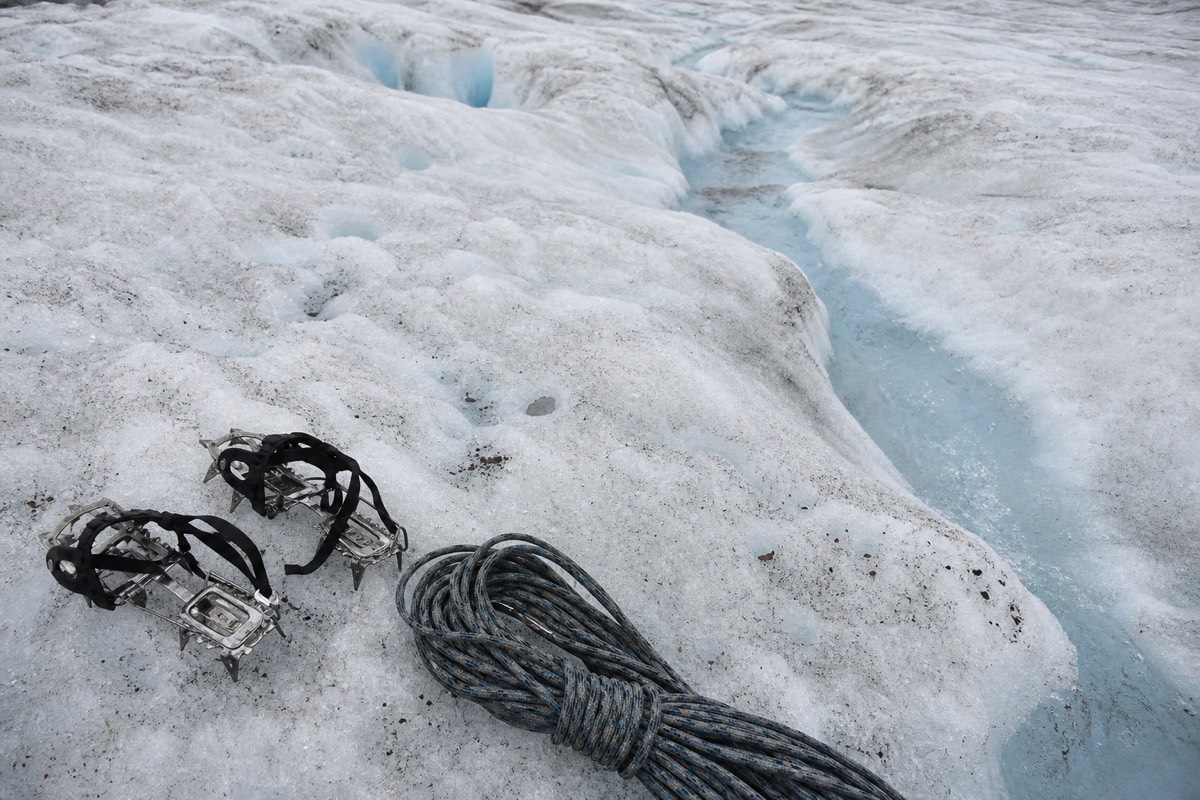
The structure of the day is worth picturing. You are not stepping off a path onto the glacier. The ice is reached by boat, then on foot along the lateral edge, and only after a briefing and a crampon fitting do you go up. Once on the surface you are walking a small area of the terminus among pressure ridges, meltwater channels and the small blue holes that form where water has drilled down through the ice. It is the only way to be on Grey rather than beside it.
The age gate is firm and catches families out. Fourteen at the lower end rules out most children, and 65 at the upper end rules out plenty of perfectly fit walkers, which is a blunt instrument but it is what is published. If either applies to somebody in your group, the cruise is the version of Grey that has no age limit attached to it.
the concessionaire that runs ice hiking on Grey publishes the current conditions and dates. We do not sell the ice hike and cannot book it for you. What we sell at Grey is the boat, and if the ice hike is the thing you want, what the kayak and ice hike involve goes through the fitness gates, the kit and the cancellation rules in detail.
What is kayaking among the icebergs like?
Kayaking on Lago Grey is published at around $244 for roughly three hours, paddling among the icebergs at the southern end of the lake rather than up to the glacier face. It is the closest most people get to touching the ice, and it is entirely weather-dependent.
The appeal is scale from water level. Sitting in a kayak your eyeline is perhaps a metre above the surface, so a berg that looked modest from the beach becomes a wall, and the sound of ice creaking and dropping carries across flat water in a way it never does over an engine. That last point is the real argument for paddling over sailing: silence.
The catch is the same wind that governs everything else here. Lago Grey funnels air off the ice field and builds through the afternoon, and a lake that was glass at nine can be unpaddleable by two. Sessions go early for that reason. Everything else, the age gates, the kit, the fitness expectations and how it slots into a trek, we have put in the dedicated guide rather than repeating here.
Which of the four ways suits your trip?
The cruise if you have one day and want the face. The walk from Paine Grande if you are already trekking. The kayak if you want silence and can spare a morning. The ice hike if being on the glacier is the point and you are between 14 and 65. Those four sentences settle it for most people.
What people actually get wrong is the assumption that these are ranked. They are not four grades of the same experience, they are four different views of the same object. The cruise gives you the face head-on. The walk gives you the tongue in profile over several hours. The kayak gives you the icebergs at eye level. The ice hike gives you the surface underfoot and no view of the face at all. Somebody who has done the ice hike has not seen what the cruise passengers saw, and the reverse is equally true.
The second mistake is time budgeting. Only the beach walk fits into the edges of another day. Everything else is the day. If your park visit is 48 hours long, Grey takes one of them, and that trade-off is the real decision.
| Way to see Grey | Typical duration | Published price | How close you get | What cancels it |
|---|---|---|---|---|
| Scenic cruise from the Hotel Lago Grey pier | 3 hours | $120 | The calving face from the water | Wind on the lake |
| On foot, Paine Grande to Refugio Grey and the mirador | A full day each way, plus 2 hours at the mirador | Trail is free, park entry applies | The tongue in profile from above | Trail closures, not usually wind |
| Kayak among the icebergs | About 3 hours | About $244 | Arm's length from floating ice | Wind, more easily than the boat |
| Guided ice hike with crampons | About 5 hours | Not consistently published | Standing on the glacier surface | Wind, conditions, and the 14 to 65 age gate |
Is Glacier Grey worth it?
For a first visit to Torres del Paine, yes, with one condition: it has to be planned as a day rather than squeezed in. Grey sits in the western half of the park, far from the towers, and every version of seeing it costs you most of a day. Given that day, it is the best glacier experience in the park by a distance.
The case against is honest and worth hearing. If you have two days and the granite towers are why you came, Grey is the thing to drop. The Base Torres trail and the Grey sector are at opposite ends of a park that takes hours to cross, and trying to do both properly in 48 hours produces two rushed days instead of one good one. Anyone weighing that trade should read which day hikes repay a single day best before locking anything in.
The case for is that Grey is the only part of the park that is not about rock. Steppe, lake and granite are what Torres del Paine sells, and they are all variations on a theme you will have seen by lunchtime on day one. Ice is a different category of thing. It moves, it makes noise, it drops, and the light on it does something no cliff face does. It also happens to be the most weather-resilient attraction in the park, in the sense that a low grey ceiling that hides the towers completely does nothing at all to a glacier.
That last point decides more trips than people expect. Cloud is the standard park condition, the towers are frequently invisible, and a Grey day gives you something to look at when the massif has disappeared. If your itinerary has a spare day and the forecast is poor, spending it at the glacier rather than on a viewpoint is usually the better call.
Recommended tours by season
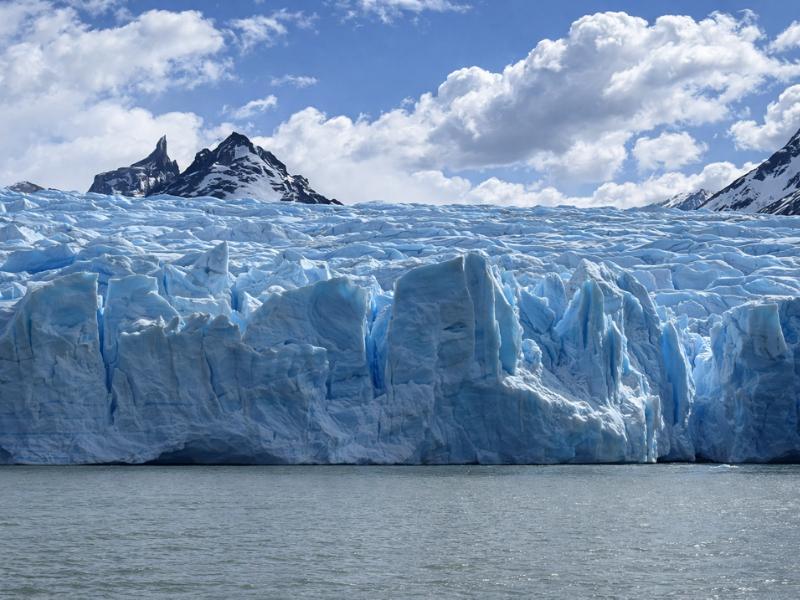
Torres del Paine: 3-Hour Grey Glacier Scenic Cruise
The option that still publishes dates outside the October-to-April ice-activity window. Sails Lago Grey to the calving face.
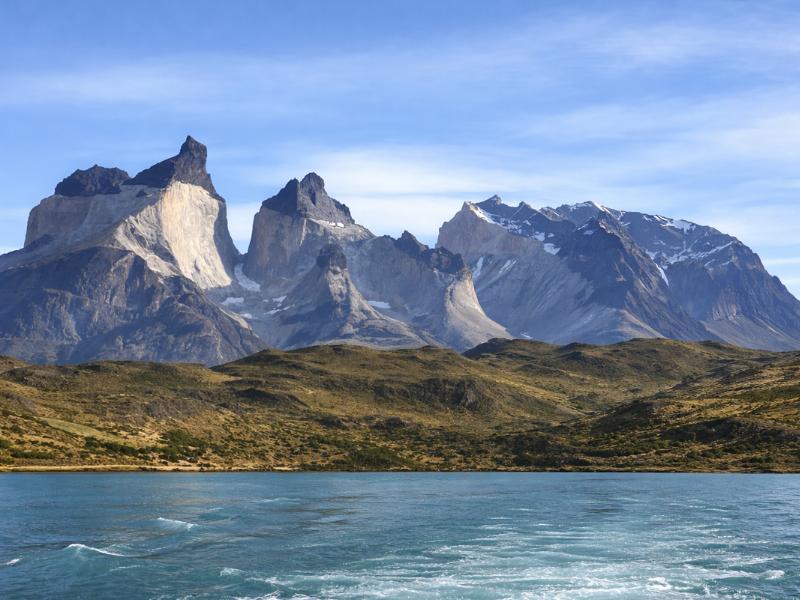
Torres del Paine W Trek Alternative 3-Day Guided Tour
Fits the October-to-April trekking window. Grey viewpoint, Base Torres and Valle Francés, two nights at Camping Pehoé.
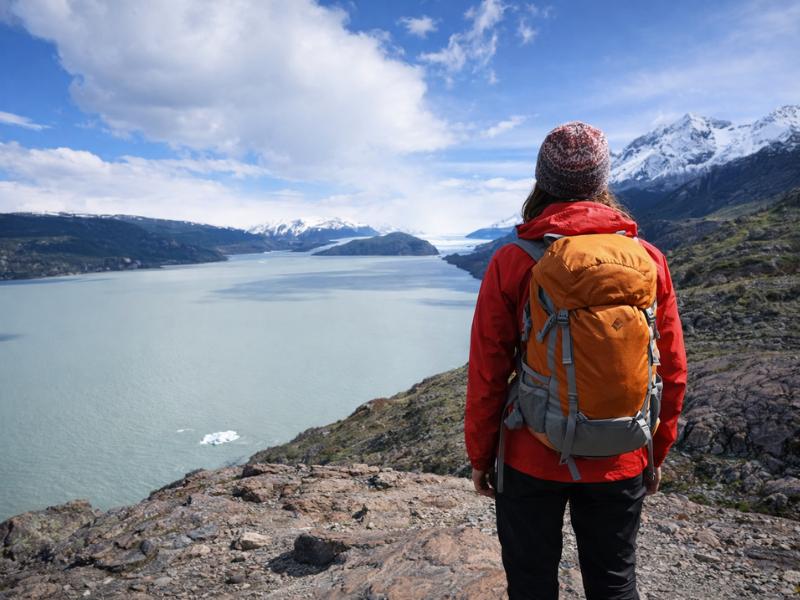
5-Day Torres del Paine W Trek – Guided Patagonia Adventure
A longer guided W in the same trekking season, if you want the western arm as walking days rather than a boat day.
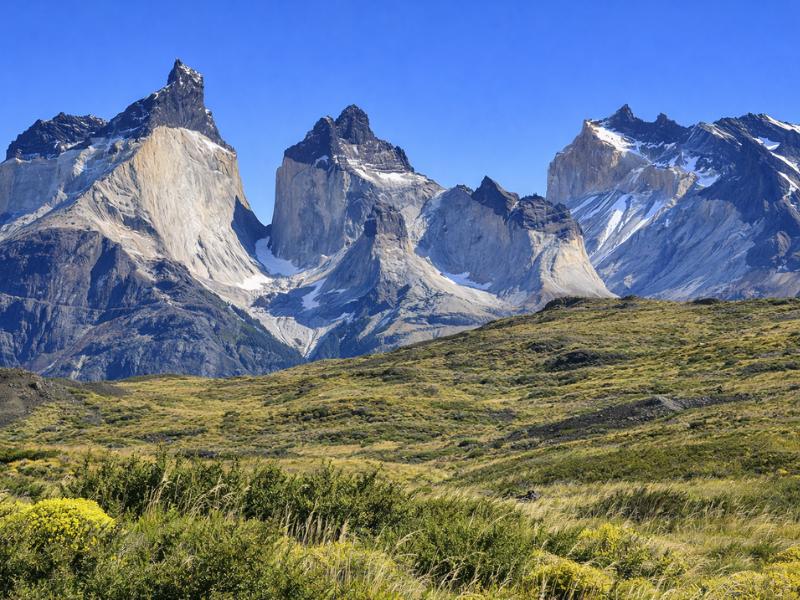
Torres del Paine Full-Day Adventure Tour from Puerto Natales
A single park day from Puerto Natales. Lake and viewpoint circuit; it does not reach the glacier front.
When should you go, and what does the wind do to your plans?
Aim for a morning slot and the earlier the better. Wind in Torres del Paine builds through the afternoon almost every day, and it is wind rather than rain or cold that cancels sailings and kayak sessions. November is the windiest month in the regional record at an average 37 kph, and gusts up to about 193 kph have been reported in the park.
Treat that gust figure as an extreme rather than a forecast. What people actually meet in summer is gusts of 60 to 100 kph, which is enough to stop you walking in a straight line on an exposed shore and more than enough to close a lake to small boats. the climate normals for Puerto Natales come from a station 112 kilometres away, and the park itself is windier and wetter than the town, so read the table below as a baseline rather than a park reading.
Season matters as much as time of day. The kayak and the ice hike run October to April only. The cruise operates more widely but is still hostage to conditions. Light is the other variable: late December gives Puerto Natales roughly 05:00 to 22:00 of daylight, so an early sailing is genuinely early and still leaves a whole day behind it, while an April day gives you far less room to recover from a cancellation.
If you want the full picture across the year rather than the glacier-specific version, what each month delivers on wind and rain has the complete table with the wet-day counts.
| Month | Avg high | Precipitation | Avg wind | Daylight |
|---|---|---|---|---|
| October | 8.2 C | 127 mm | 33 kph | 13.5 h |
| November | 9.9 C | 154 mm | 37 kph | 15.5 h |
| December | 11.5 C | 155 mm | 34 kph | 17.0 h |
| January | 12.6 C | 147 mm | 32 kph | 16.5 h |
| February | 13.1 C | 120 mm | 31 kph | 15.0 h |
| March | 11.4 C | 145 mm | 30 kph | 13.0 h |
| April | 8.4 C | 154 mm | 29 kph | 11.0 h |
Grey Glacier or Perito Moreno: which should you actually visit?
They are in different countries and hundreds of kilometres apart, so this is a routing question rather than a ranking. Grey is in Chile inside Torres del Paine, reached by boat or on foot. Perito Moreno is in Argentina near El Calafate, has extensive boardwalks and is far easier to reach. If your trip includes both towns, do both.
Perito Moreno wins on access and on visible calving. You arrive by road, walk out onto a network of steel walkways facing the ice, and stay as long as you like with no boat, no booking window and no wind cancellation to worry about. It calves more visibly and more often from a fixed vantage point, which is why it produces the videos everybody has seen.
Grey wins on context and on quiet. It is not a single attraction with a car park, it is part of a park you are already walking through, and the ways to reach it are the interesting part. Nobody stands in a crowd on a viewing platform at Grey. One clarification while comparing them: do not repeat the old line about Perito Moreno advancing. That claim has not held up, and recent work points to retreat there too.
If you are approaching from the Argentine side, the practical routing question is covered in how the El Calafate crossing actually works, and there is a longer evaluative piece at the direct Grey and Perito Moreno comparison.
| Grey Glacier | Perito Moreno | |
|---|---|---|
| Country | Chile, inside Torres del Paine | Argentina, near El Calafate |
| How you reach it | Boat across Lago Grey, or on foot | Road, then extensive boardwalks |
| Effort required | Most of a day, whichever way you choose | A half day, with no walking obligation |
| Visible calving | Happens, but not on demand | Calves more visibly and more often |
| Weather sensitivity | High, wind cancels boats and kayaks | Low, the walkways stay open |
| Crowds | Limited by boat capacity and trail length | Substantial at the main viewpoints |
How do you fit Grey into a day visit or a W trek?
On a single day from Puerto Natales, Grey is the whole day: 112 kilometres of road each way, 2 to 3 hours in each direction, and a park entry ticket at 34,000 CLP for a foreign adult. On a W trek, Grey is the western arm and usually the first or last full day depending on which direction you walk.
The day-visit maths is unforgiving. Leaving town around 07:00 is normal, the drive eats four to six hours of the day return, and the boat needs three. That leaves very little slack, which is why a cancelled sailing on a day trip is a bad outcome and why the beach walk matters as a fallback. Entry is bought in advance from the official park ticketing portal and the ticket is date-locked, so a weather day spent in town is money already gone. Anyone doing this independently should also budget the 4,000 to 4,500 CLP shuttle and the roughly 26,000 CLP catamaran if the itinerary uses them, both of which are covered in what park entry and transport really cost.
On a trek the calculus flips. Walking west to east, which is the more common direction and the one most packages sell, you take the catamaran to Paine Grande, walk the Grey arm first while your legs are fresh, and finish at the towers. Walking the other way puts the glacier at the end. how the W is structured day by day lays out both directions.
If you would rather not assemble any of this yourself, three of the nine Torres del Paine tours we list put you at the glacier. the three-day guided W alternative covers the Base Torres trail, Valle Francés and the Grey Glacier viewpoint while sleeping two nights at Camping Pehoé, so full packs are not carried daily. the full-day adventure tour from Puerto Natales is the wide-angle version of the park, reaching Lago Pehoé, Salto Grande and the Nordenskjöld viewpoint rather than the glacier front.
| What we sell that reaches Grey | From price | Duration | What it gives you at the glacier |
|---|---|---|---|
| Grey Glacier scenic cruise | $120 | 3 hours | The calving face from the water, plus the iceberg run up the lake |
| W Trek alternative, three-day guided | $1,175 | 3 days | The Grey Glacier viewpoint on foot, alongside Base Torres and Valle Francés |
| Full-day adventure from Puerto Natales | $139 | 8 to 10 hours | The park's lake and viewpoint circuit rather than the glacier front |