The Best Day Hikes in Torres del Paine, Ranked by Effort
Most people who visit Torres del Paine never sleep inside it. These are the walks that fit into a day, with the real numbers attached to each one.
CONAF counted 367,426 people through Torres del Paine in 2024, and only a small share of them ever slept inside the park. The majority arrived on a bus in the morning and were back in Puerto Natales for dinner. That is the normal way to see this place. It is also the way the park is best set up for, whatever the trekking forums imply, because roughly 130 km of marked trail sits inside those gates and a good deal of it is reachable from a road.
What follows is every walk that works as a day hike, with the distance, the ascent and the honest time attached to each one. Some of them take half an hour. One of them takes ten.
How far each day hike actually is
Commonly published distances; park signage rounds differently and the Británico figure runs from 7.5 to 12 km depending on where the count starts.
Which Torres del Paine day hikes can you do without booking a refugio?
Eight walks start from a road, a car park or a boat pier and need no bed reservation at all: Salto Grande at 1.5 km, Mirador Condor at 3 km, Mirador Cuernos at 4 km, the Ferrier lookout at 4 km, the Lago Grey beach at 2 km, Laguna Azul at 19.4 km, the Pingo valley at 21 km, and Base Torres at 21 km round trip with 1,041 metres of ascent. Everything else in the park, the French Valley included, sits behind either a long approach or a night in a refugio.
That distinction matters more than any difficulty rating. Torres del Paine has three separate booking systems, one for park entry and two for beds, and the walks below sidestep two of them entirely. You buy an entrance ticket, you get yourself to the trailhead, and you walk. The only paperwork is the QR code on your phone, and what the park ticket covers and what it does not is worth reading before you turn up at a gate.
The ranking below is by effort rather than by scenery, because effort is the thing people misjudge. The gap between the shortest and the longest walk on this list is a factor of fourteen in distance and twenty in time. Nobody accidentally does Salto Grande instead of Base Torres, but plenty of people book a Base Torres day expecting something closer to a strenuous afternoon.
| Walk | Distance | Ascent | Typical time | Starts from |
|---|---|---|---|---|
| Salto Grande | 1.5 km out and back | 20 m | 30 minutes | Pudeto car park |
| Lago Grey beach | 2 km out and back | 50 m | 1 hour | Guarderia Grey |
| Mirador Condor | 3 km out and back | 200 m | 1.5 hours | Near Pudeto |
| Mirador Cuernos | 4 km out and back | 150 m | 1.5 hours | Salto Grande |
| Ferrier lookout | 4 km out and back | 300 m | 2 hours | Lago Grey |
| Laguna Azul area walk | 19.4 km out and back | 470 m | 5 hours | Laguna Azul road |
| Pingo valley | 21 km out and back | 750 m | 6 hours | Lago Grey sector |
| Base Torres | 21 km round trip | 1,041 m | 8 to 10 hours | Welcome Center |
What is the most famous hike in Torres del Paine?
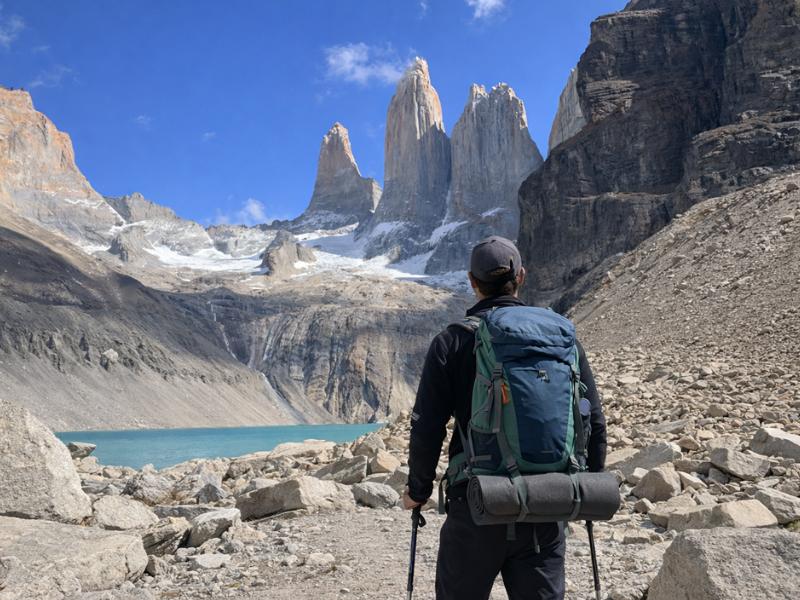
Base Torres, the walk up the Ascencio valley to Mirador Las Torres, where a grey glacial lagoon sits at the foot of the three granite towers. It is 21 km round trip from the Welcome Center with 1,041 metres of ascent and takes 8 to 10 hours. Our own guided day trip lists it slightly shorter, at 20 km and 870 m. Both figures are in circulation and the difference comes from where the count starts.
The image every visitor has seen is taken from the boulder field at the top of that trail. Three vertical granite shafts rise straight out of a moraine bowl with a milky lake at their base, and in good light the rock goes orange for about twenty minutes after sunrise. The rest of the time it is grey, which is the part the photographs do not prepare people for.
The trail itself splits into three unequal pieces. The first is a long exposed climb out of the valley floor onto a windy shoulder, and it is where most of the day's suffering happens even though it looks like the easy bit on a profile. The middle is a gentle traverse through lenga forest along the Ascencio river, shaded and pleasant and quick. The last 0.8 km is the moraine: a chaotic pile of boulders climbing about 200 metres in 45 minutes, with painted markers instead of a path. There is no scrambling in the technical sense, but there is a great deal of stepping up onto rock at knee height when the legs are already done.
We break the trail down in far more detail in the full Base Torres trail write-up, including where the two control points sit. If you are walking it as part of a longer route, the same mirador is the closing act of the eastern arm on the four to five day W trek.
| Section | What it is | Distance | Time up |
|---|---|---|---|
| Welcome Center to the shoulder | Open, exposed, steady climb | About a third of the way | 1.5 to 2 hours |
| Shoulder to Refugio Chileno | Traverse above the river | Short, mostly level | 30 to 45 minutes |
| Chileno to Campamento Torres | Lenga forest, gentle grade | The middle third | 1 to 1.5 hours |
| Final moraine to the mirador | Boulder field, painted markers | 0.8 km | 45 minutes |
How difficult is the Torres del Paine hike?
Base Torres is a long day rather than a technical one. There is no exposure, no scrambling that needs hands beyond balance, and no altitude. What it demands is 8 to 10 hours of continuous walking, 1,041 metres up and the same again down, and the willingness to finish the last 45 minutes on loose boulders in wind. Fit walkers do it in eight. The people who struggle are almost never unfit. They are people who have not walked for eight hours in one go before.
The honest failure mode is the descent. Coming down the moraine and then re-losing 1,041 metres on tired quadriceps is where knees complain and where most of the turned ankles happen. This is the single strongest argument for poles, and it is why the guided Base Torres day trip includes Black Diamond poles as standard rather than as a rental extra.
Weather changes the answer more than fitness does. The Ascencio valley funnels wind, and the shoulder near the start is one of the more consistently blown sections of trail in the eastern park. Summer gusts of 60 to 100 kph are what people actually meet, and regional sources have reported extremes up to about 193 kph in the park, which is not a normal day but does tell you what the terrain is capable of. Add rain and the boulders turn greasy.
There is also a rule that catches winter visitors: from 27 April to 30 August 2026 the Base Torres trail may only be walked with an authorised guide. That is not a recommendation, it is a CONAF condition, and it is published alongside the rest of the park's seasonal closures at the park authority's own page. If you want the shorter answer on fitness, we wrote one at how hard the Torres del Paine hike really is.
How much walking actually fits into a bus day from Puerto Natales?
Between two and three hours on your feet, spread across three or four short stops, unless you have booked a trekking day specifically. A standard full-day tour leaves Puerto Natales around 07:00, spends 2 to 3 hours covering the 112 km to the park, and returns between 17:00 and 18:00. The walking inside that is a 30 minute leg to Salto Grande plus viewpoints. That is not a criticism of the format. It is the format.
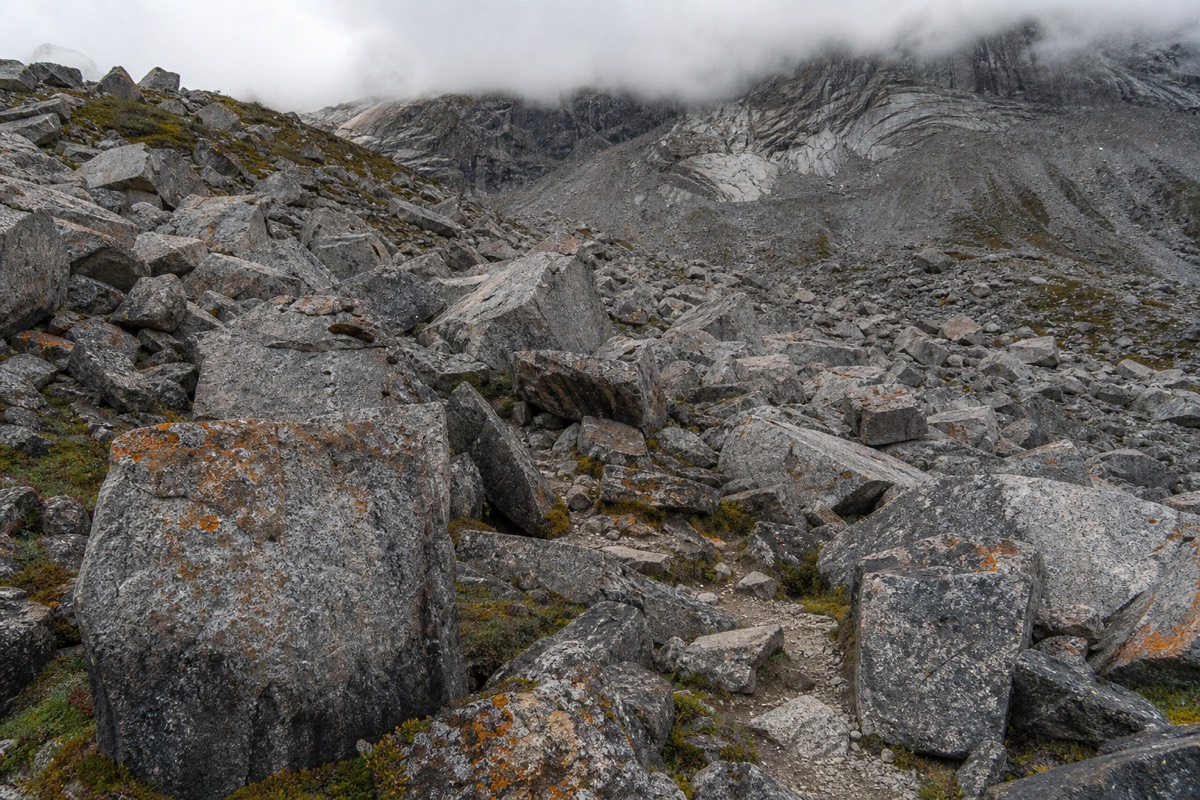
The arithmetic is unforgiving. The road from Puerto Natales to Laguna Amarga is 112 km and takes 2 to 3 hours each way, which removes five hours from a twelve hour day before anyone opens a car door. Add the internal driving between Sarmiento, Laguna Amarga, Pudeto and Lago Grey and you are left with the remainder. A scenic day trip fills that remainder with six or seven stops. A trekking day trip spends all of it on one trail.
This is why the two products look so different on paper. The full day scenic circuit runs 8 to 10 hours, costs $139 and takes in Villa Cerro Castillo, the Sarmiento viewpoint, Laguna Amarga with its flamingos and frontal tower view, the Salto Grande walk, the Nordenskjöld viewpoint, Lago Pehoé and the Milodon Cave. The Base Torres trekking day runs 10 to 12 hours, costs $99, picks up between 06:30 and 07:00, and gets you back to town between 20:00 and 21:00 having walked one trail and nothing else.
Both are honest uses of a day. Choosing between them is really a question of whether you want to have seen the park or to have walked in it. More on how the road itself works is in the Puerto Natales to park transport guide.
| Rough hour | Scenic full day | Base Torres trekking day |
|---|---|---|
| 06:30 to 07:00 | Hotel pickup in Puerto Natales | Hotel pickup in Puerto Natales |
| 07:00 to 09:30 | Drive north, Villa Cerro Castillo stop | Two hour drive to the Amarga sector |
| 09:30 to 12:00 | Sarmiento, Laguna Amarga, tower viewpoint | Climb to the shoulder and on to Chileno |
| 12:00 to 15:00 | Salto Grande walk, Nordenskjöld viewpoint | Forest traverse, moraine, the mirador |
| 15:00 to 18:00 | Lago Pehoé, Milodon Cave, return | Full descent to the Welcome Center |
| 18:00 to 21:00 | Back in town by 17:00 to 18:00 | Drive back, town by 20:00 to 21:00 |
The short walks around Pudeto: Salto Grande, Mirador Condor and Mirador Cuernos
Recommended tours by season
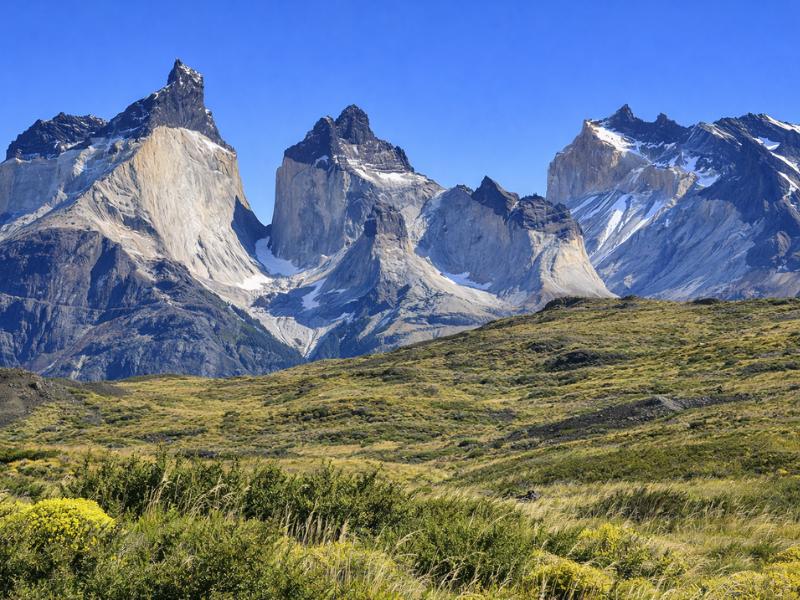
Torres del Paine Full-Day Adventure Tour from Puerto Natales
For the long-day months: an 8 to 10 hour circuit of Sarmiento, Laguna Amarga, Salto Grande, Nordenskjöld and Lago Pehoé, with pickup in Puerto Natales.
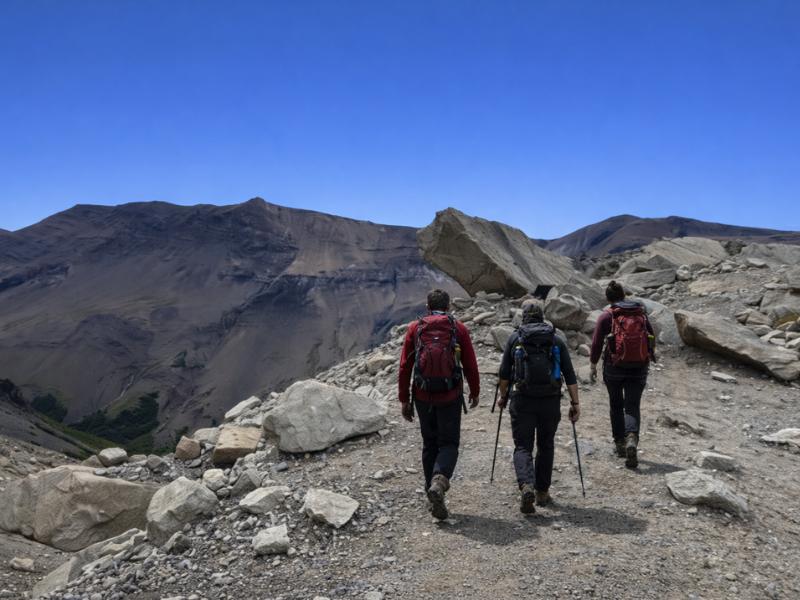
Torres del Paine Base Torres Trekking Day Trip from Puerto Natales
The 21 km walk to the towers. It runs as a guided day trip year-round, which is also how the park requires the trail to be walked in winter. Poles and crampons included when there is ice.
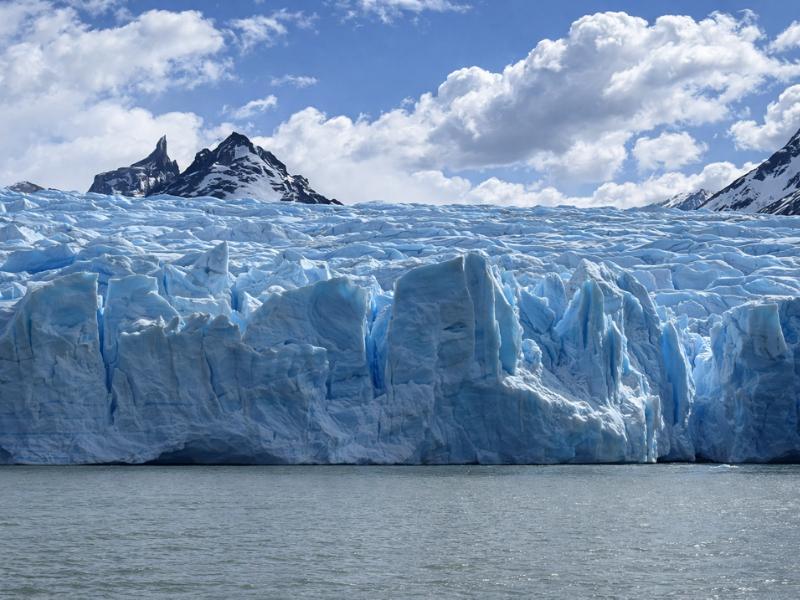
Torres del Paine: 3-Hour Grey Glacier Scenic Cruise
Three hours from the Hotel Lago Grey pier to the glacier front. May is the calmest month, which matters because wind is what cancels these sailings.
Torres del Paine 2-Day Express Tour – Aventura & Highlights
Base Torres on day one, Condor, Cuernos and the Aonikenk trail on day two, with a night at Pehoé so the second day is not spent on the road back to town.
These three share a car park and cover 1.5 km, 3 km and 4 km respectively, with 20 m, 200 m and 150 m of ascent. Salto Grande takes 30 minutes, the other two about 90 each. Together they make a genuinely full day of walking for someone who has no interest in an eight hour trail, and they deliver the Cuernos from three different angles.
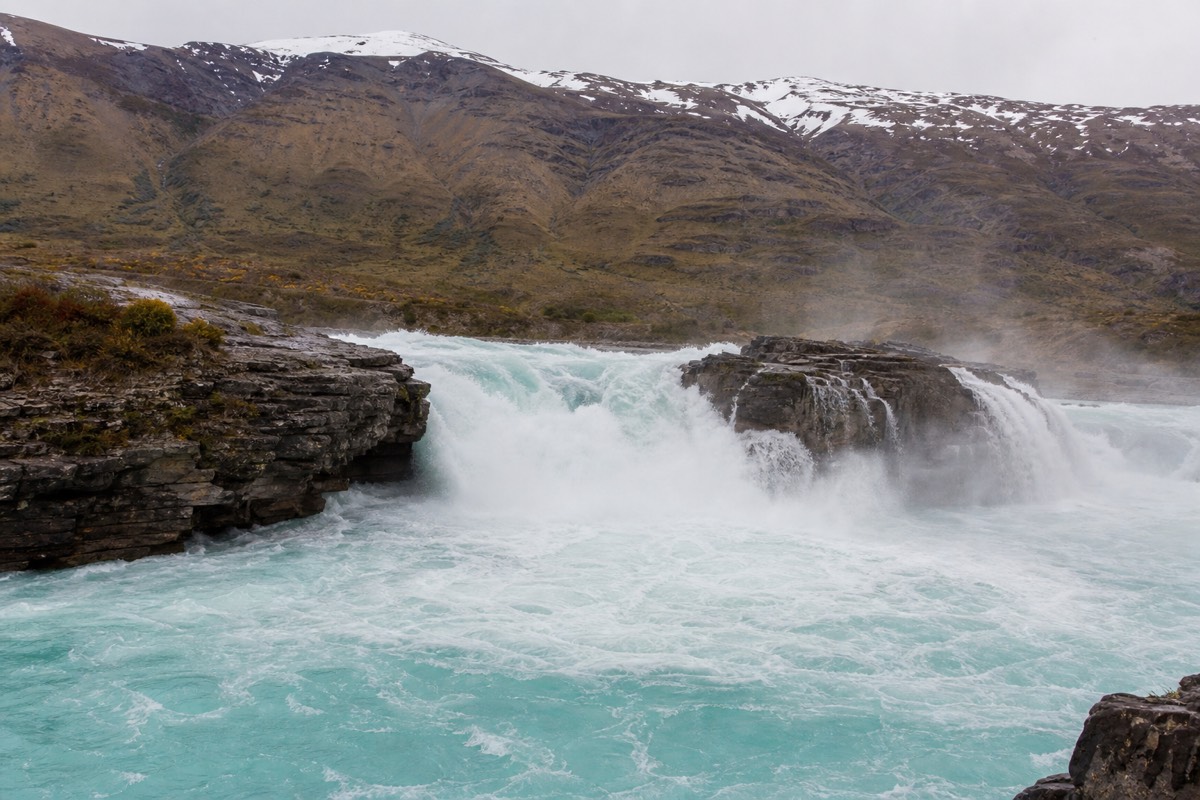
Salto Grande is the waterfall between Lake Nordenskjöld and Lago Pehoé, a wide short drop with an enormous volume of water going over it. The walk is flat gravel and takes half an hour there and back, which is why it is the one piece of trail almost every bus tour includes. It is also one of the windiest spots most visitors will stand in, because the gap the river uses is the same gap the wind uses.
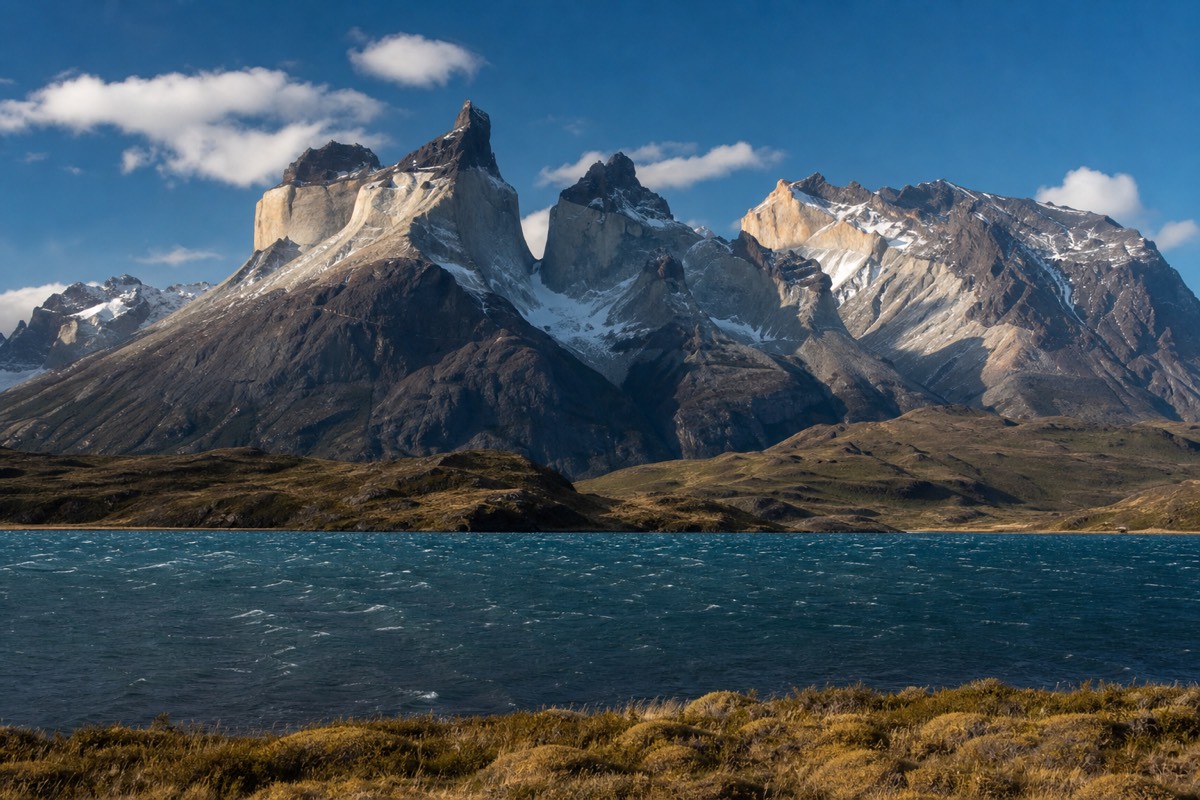
Mirador Cuernos continues from Salto Grande along the shore of Nordenskjöld for another 4 km round trip, gaining 150 metres, and puts the horns directly across the water with nothing in between. This is the view on the postcards that are not of the towers. Ninety minutes, easy underfoot, and most day tours do not include it, so it is one to ask about specifically.
Mirador Condor is the odd one out and the best value of the three. It climbs 200 metres over 3 km round trip from near Pudeto and gives you the entire massif in one frame with Lago Pehoé beneath it, which no roadside viewpoint manages. It is steep enough to feel like exercise and short enough that it is over before it becomes work. Our two day express trip puts Condor and the Cuernos viewpoint together on its second day, alongside the Aonikenk trail with its rock paintings.
The Grey sector on foot: the beach, Ferrier and the Pingo valley
Three walks leave from the Lago Grey road, and they cover 2 km, 4 km and 21 km. The beach walk is an hour on flat sand and gravel to a shoreline where icebergs from Grey Glacier ground against the terminal moraine. Ferrier climbs 300 metres in 4 km for two hours. The Pingo valley is a full 6 hour, 750 metre day almost nobody does.
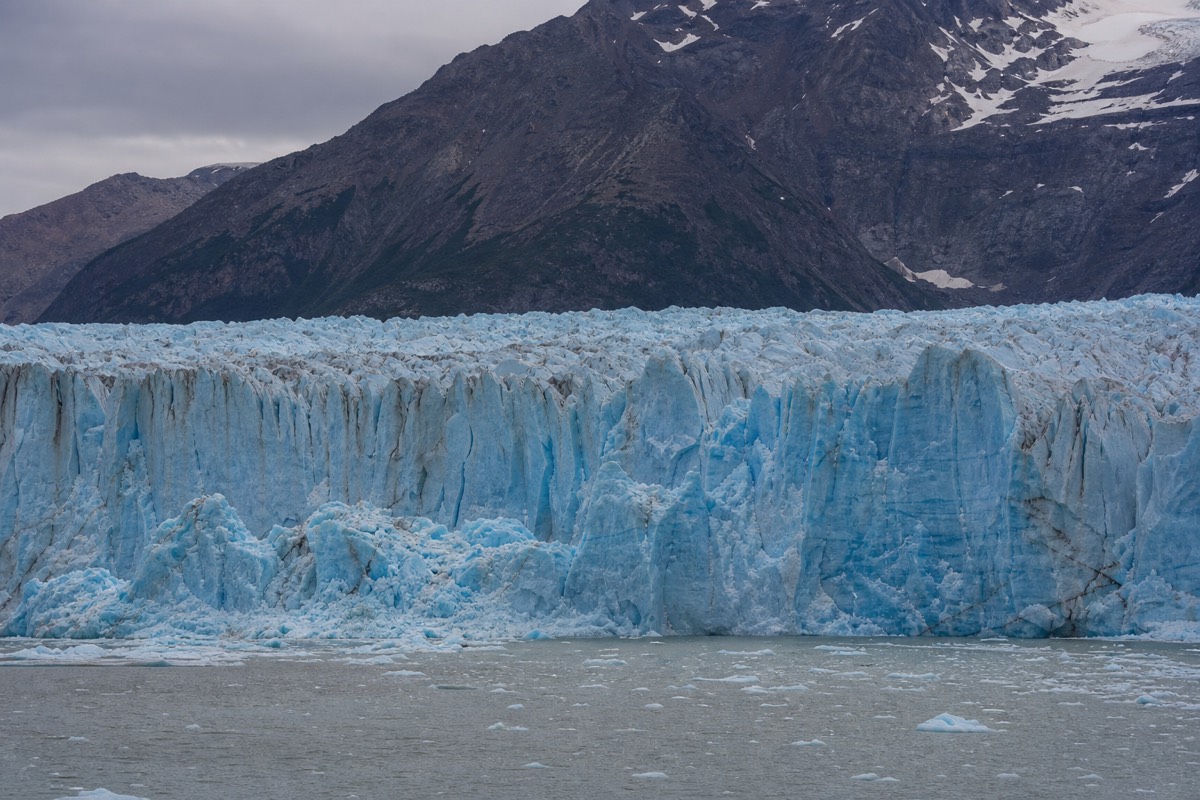
The beach is the surprise. Grey Glacier is 28 km long, about 6 km wide and covers roughly 270 km2, flowing off the Southern Patagonian Ice Field, and its face stands around 30 metres above the water. You cannot see any of that from the beach. What you can do is stand next to house sized chunks of it that have drifted the length of the lake and stranded, which for an hour of flat walking is an extraordinary return. Wind pushes the ice around, so some days the beach is crowded with it and some days it is bare.
Ferrier is the effort option, a steep 300 metre climb to a lookout with the lake, the ice and the massif laid out together. Two hours, and worth it on a clear day only. Pingo goes the other way, south into forest along the Pingo river, and at 21 km with 750 metres of ascent it is as long a day as Base Torres without any of the fame. It sees a fraction of the traffic.
None of these three shows you the glacier front. That needs either the 3 hour cruise from the Hotel Lago Grey pier or a walk in from Paine Grande, and we cover both routes in the Grey Glacier guide. Wind cancels the sailings regularly, which is the one thing to plan around.
| Grey sector walk | Distance | Ascent | Time | What you get |
|---|---|---|---|---|
| Lago Grey beach | 2 km out and back | 50 m | 1 hour | Stranded icebergs at eye level |
| Ferrier lookout | 4 km out and back | 300 m | 2 hours | Lake, ice and massif together |
| Pingo valley | 21 km out and back | 750 m | 6 hours | Forest, river, near total solitude |
| Refugio Grey to Mirador Grey | 5.6 km out and back | 150 m | 2 hours | Glacier front and the bridges |
Laguna Azul: the towers from the north, and why almost nobody goes
Laguna Azul sits on a separate northern access road rather than behind the three main porterias, and the area walk is 19.4 km out and back with 470 metres of ascent, about 5 hours. It gives a frontal view of the three towers across a blue lake, from the opposite side to the one every photograph is taken from, and it is quiet in February.
The reason it stays quiet is access. Laguna Amarga, Lago Sarmiento and Rio Serrano are the three entrances the buses use, and Laguna Azul is none of them. Getting there realistically means a rental car on ripio, which comes with its own warnings: gravel, no fuel anywhere inside the park, and enough wind that rental agents specifically caution about doors being torn back on their hinges.
What you trade for that hassle is the composition. From the south the towers rise out of the Ascencio valley and you work for the angle. From Laguna Azul they stand at the far end of a lake with open steppe in front of them, which is the classic wide frame with guanacos in it. Guanaco numbers in the park are commonly cited at around 3,000, an older estimate and an approximate one, and the eastern steppe is where the herds actually are.
If a car is part of your plan anyway, the six day self drive package hands over a category D vehicle with unlimited mileage and five nights of accommodation, which makes the northern road a realistic afternoon rather than a project. If it is not, treat Laguna Azul as a thing to know exists rather than a thing to chase.
French Valley and the Grey mirador: day hikes only if you sleep inside the park
From Campamento Italiano the walk to Mirador Francés is 3.9 km out and back with 274 metres of ascent, about 1.5 hours, and Mirador Británico is 7.5 to 12 km out and back with 640 metres of ascent, 3.5 to 4 hours. From Refugio Grey the mirador and suspension bridges are 5.6 km round trip. All three need a bed inside the park first.
Sources genuinely disagree on the Británico distance, which is why the range above is so wide. Some measure from Italiano, some from the Francés mirador, and the amphitheatre at the top is a place people wander around in rather than a fixed point. Take the 3.5 to 4 hour figure as the more reliable of the two numbers.
The reason these are not day hikes for a visitor based in Puerto Natales is arithmetic again. Italiano is reached from Paine Grande, and Paine Grande is reached by catamaran across Lago Pehoé from Pudeto, about 30 minutes and roughly 26,000 CLP one way, with high season departures commonly listed around 08:30, 10:30, 16:15 and 18:00. Sailings are cancelled in high wind. Chaining a bus, a catamaran, a 7.5 km approach, the valley itself and the whole thing in reverse does not fit between two boats.
Sleep at Paine Grande or Refugio Grey and both become straightforward half days. That is the real argument for one night inside the park rather than none, and how the two separate refugio booking systems work is the first thing to understand if you want to try. The valley itself gets its own treatment in the French Valley guide.
How do you pick one hike by the hours you have?
Work backwards from walking hours, not from what you want to see. Under an hour buys Salto Grande. Two hours buys Mirador Condor or the Grey beach. Three to four buys Condor plus the Cuernos viewpoint. Five to six buys Laguna Azul or Pingo. Eight to ten, and only eight to ten, buys Base Torres. There is no shortened version of the last one.
The most common planning mistake we see is people trying to fit Base Torres into a day that also includes a scenic circuit. It does not fit, and the compromise attempts end in a turnaround at Chileno with the towers unseen. If Base Torres is the reason you came, give it the whole day and see the Cuernos and the glacier on a different one.
The second most common is the reverse: booking the trekking day when what the group actually wants is scenery, a warm bus and a waterfall. Two thirds of a Base Torres day is spent looking at the inside of a valley. It is a superb valley. It is not a highlights reel.
| Walking hours available | Pick this | Why |
|---|---|---|
| Under 1 hour | Salto Grande | Flat, 30 minutes, on every bus route |
| 1 to 2 hours | Lago Grey beach or Mirador Condor | Icebergs at sea level, or the whole massif |
| 2 to 3 hours | Mirador Cuernos from Salto Grande | The horns across Nordenskjöld, easy underfoot |
| 3 to 4 hours | Condor plus Ferrier | Two contrasting viewpoints, both short climbs |
| 5 to 6 hours | Laguna Azul or the Pingo valley | Long, flat-ish, and almost empty |
| 8 to 10 hours | Base Torres | The towers, the lagoon, the moraine |
| Overnight inside the park | French Valley or Mirador Grey | Unreachable in a day from town |
What the wind and the weather do to a day hike plan
Wind is the variable that changes a day here, not rain or cold. Puerto Natales averages 37 kph in November, its windiest month, and 28.5 kph in May, its calmest. The park is windier than the town. Everyday summer gusts of 60 to 100 kph are normal, and the wind almost always builds through the afternoon, which is an argument for early starts on every walk on this list.
The seasonal shape is simple enough. January and February bring 12.6 C and 13.1 C average highs with 16.5 and 15 hours of daylight, and they are also the two busiest months in the park. March cools to 11.4 C and calms slightly. September is the driest month at 103 mm, and May the calmest, but both come with short days and a guide requirement on the Base Torres trail.
The other thing worth knowing is that the park has two weather systems. The western side, meaning Grey and Paine Grande, is significantly wetter than the eastern steppe around Laguna Amarga. A morning that is being rained out at Grey can be dry at the Base Torres trailhead, so a bad forecast is not automatically a cancelled day, it is a reason to move sectors. The Puerto Natales climate record gives the regional baseline, and we break the park down month by month in the monthly weather guide.
Practically: start early, carry a wind shell whatever the forecast says, and accept that the towers are in cloud a great deal of the time. Nobody controls that part. What you can control is being on the moraine at ten in the morning rather than at three in the afternoon.
| Month | Avg high | Avg wind | Wet days | Daylight |
|---|---|---|---|---|
| January | 12.6 C | 32 kph | 16 | 16.5 h |
| February | 13.1 C | 31 kph | 13 | 15.0 h |
| March | 11.4 C | 30 kph | 15 | 13.0 h |
| May | 4.9 C | 28.5 kph | 12 | 9.5 h |
| September | 5.4 C | 32 kph | 12 | 12.0 h |
| November | 9.9 C | 37 kph | 15 | 15.5 h |
| December | 11.5 C | 34 kph | 16 | 17.0 h |
Which guided day trip covers which walk?
Three of the nine trips we list are day-hike products. The $99 Base Torres trekking day walks one trail and includes poles, an assistant guide and crampons when there is ice. The $139 full day scenic circuit covers Salto Grande, the Nordenskjöld viewpoint, Laguna Amarga and the Milodon Cave. The $620 two day express does Base Torres on day one and Condor plus the Cuernos on day two.
The guide ratio on the Base Torres day is 1:6 in summer and 1:4 in winter, which is tight for a day hike and matters on the moraine. Park entrance is not included on any of them, so buy that separately at the official park ticketing portal before you travel: 34,000 CLP for a foreign adult on a single day at the time of writing, or 48,500 CLP for the pass valid up to ten consecutive days. Tickets are date locked and non refundable, so a weather day you spend in town is a ticket you have paid for.
If you want more than a day but less than a trek, the two day express is the honest middle. It puts you in a fully equipped tent at Pehoé camping between the two walks, which removes the four hours of road time that a second day trip from town would cost. Beyond that you are into multi-day territory, and the four day hotel-based experience is the version that includes all park entrance fees and a bed in Puerto Natales rather than a tent.
All nine options, with what each one actually includes, sit on the nine Torres del Paine tours we list. We do not sell accommodation, kayaking, ice hiking or puma tracking, and where those come up in these guides they are context rather than a booking. The eastern sector these day trips cover is also where the region's biggest predator is most often reported, at dawn and dusk rather than midday.
| Trip | From price | Length | Walks covered |
|---|---|---|---|
| Base Torres trekking day trip | $99 | 10 to 12 hours | Base Torres, poles included |
| Full day adventure tour | $139 | 8 to 10 hours | Salto Grande plus viewpoints |
| Two day express tour | $620 | 2 days | Base Torres, Condor, Cuernos, Aonikenk |
| Four day experience | $1,355 | 4 days | Full circuit plus Grey beach and a glacier sailing |