Torres del Paine vs El Chaltén: Which One Is Worth Your Days?
Two granite skylines, one border between them, and about twelve days needed to do both properly. Here is how the two hiking hubs really differ.
Two granite skylines sit about a day's travel apart on either side of the Chile and Argentina border, and travellers with ten days keep asking which one to give them to. The honest answer changes depending on whether you are optimising for scenery, for logistics or for money, and the three answers do not agree.
One thing to state up front. Every Torres del Paine figure below comes from our own grounded research file: distances, ascent, ticket prices, wind speeds, bus fares. For El Chaltén we are deliberately staying qualitative, because we do not hold verified numbers for Argentine trail distances or transport fares and we are not going to make them up. Where a number would help and we do not have one, we say so.
The side of this comparison we can put numbers on
The W total is commonly published as about 80 km but sources range from 60 to 85 km depending on which side trips are counted. We hold no verified equivalents for El Chaltén, so none are shown.
What is the actual difference between Torres del Paine and El Chaltén?
Torres del Paine is a ticketed Chilean national park of 227,298 hectares with a booking system, an entrance fee and a bus ride between you and the trailhead. El Chaltén is an Argentine village inside Los Glaciares National Park where the classic trails start at the end of the street. One is a destination you organise. The other is a place you walk out of.
That single structural difference drives almost everything else. In Torres del Paine you buy a park ticket in advance at pasesparques.cl, you get yourself 112 km up the road from Puerto Natales, and if you want to sleep on the trail you book beds through two separate concessionaires whose calendars open around April. In El Chaltén you arrive in the village, sleep in the village, and walk from the village.
The payoff for the Chilean complexity is a bigger and more varied park. Torres del Paine holds roughly 130 km of marked trail, a 28 km glacier flowing off the Southern Patagonian Ice Field, open guanaco steppe on its eastern side and the densest known puma population anywhere. El Chaltén concentrates on granite and does it very well. Which of those you want is genuinely a preference and not a ranking.
Both sit under the same weather. Frontal systems cross the whole of southern Patagonia and neither side gets a materially better deal, whatever the person you meet in a hostel tells you.
| Torres del Paine | El Chaltén | |
|---|---|---|
| Country | Chile, Magallanes region | Argentina, Santa Cruz province |
| Base town | Puerto Natales, 112 km away | The village itself, trailheads in town |
| Park size | 227,298 hectares, established 1959 | Part of Los Glaciares National Park |
| Headline sight | The three towers and Grey Glacier | Fitz Roy and Cerro Torre |
| Entrance | Ticketed, bought online in advance | No gate on the classic day trails |
| Signature trek | The W, about 80 km, 4 to 5 days | Day hikes from the village, plus a traverse |
| Nearest airport | Punta Arenas, PUQ | El Calafate, FTE |
Two countries, two sets of logistics
Torres del Paine is reached through Punta Arenas or Puerto Natales in Chile. El Chaltén is reached through El Calafate in Argentina. Moving between them means a land border, and the standard bus route from El Calafate to Puerto Natales takes about 6 hours plus the crossing itself, runs roughly $40 to $50, and uses the Cerro Castillo post. Plan a full day for it whichever direction you go.
On the Chilean side the chain is well worn. Santiago to Punta Arenas is about 3h30m and one way fares commonly run $65 to $200. Punta Arenas to Puerto Natales is 250 km and 3 to 4 hours by bus, roughly $9 to $26, with several departures a day including airport pickups. Puerto Natales to the park gate is 112 km and 2 to 3 hours, roughly $20 to $29, with high season departures commonly around 06:45, 07:00, 12:00 and 14:30. Puerto Natales also has a small airport, PNT, served by three carriers about 3h20m from Santiago, though frequencies are thin and it is mostly a summer operation.
The Argentine side runs through El Calafate, which is also the airport for Perito Moreno Glacier. That makes El Chaltén easy to bolt onto a Calafate stop, and it is why so many itineraries do the two Argentine sights together and then cross west.
Two border details that bite. Chilean immigration issues a tourist card, the PDI slip, on entry, and presenting it with your passport at hotel check-in is what triggers the 19% IVA exemption for foreign tourists paying in foreign currency. And Chile's agricultural service does not let fresh fruit, vegetables, meat, dairy or honey across the border. Eat it or bin it before the checkpoint, because the inspection is real. Rental cars need an advance cross-border permit costing around $150 and not every company allows it, which is covered in the El Calafate to Torres del Paine route guide.
| Leg | Distance or time | Published cost |
|---|---|---|
| Santiago to Punta Arenas | About 3h30m by air | $65 to $200 one way |
| Punta Arenas to Puerto Natales | 250 km, 3 to 4 hours | $9 to $26 |
| Puerto Natales to Laguna Amarga | 112 km, 2 to 3 hours | $20 to $29 |
| El Calafate to Puerto Natales | About 6 hours plus the border | $40 to $50 |
| Private transfer in Puerto Natales | No ride-hailing apps operate | Around $150 |
| Cross-border rental car permit | Arrange in advance | Around $150 |
The granite: the three towers against Fitz Roy and Cerro Torre
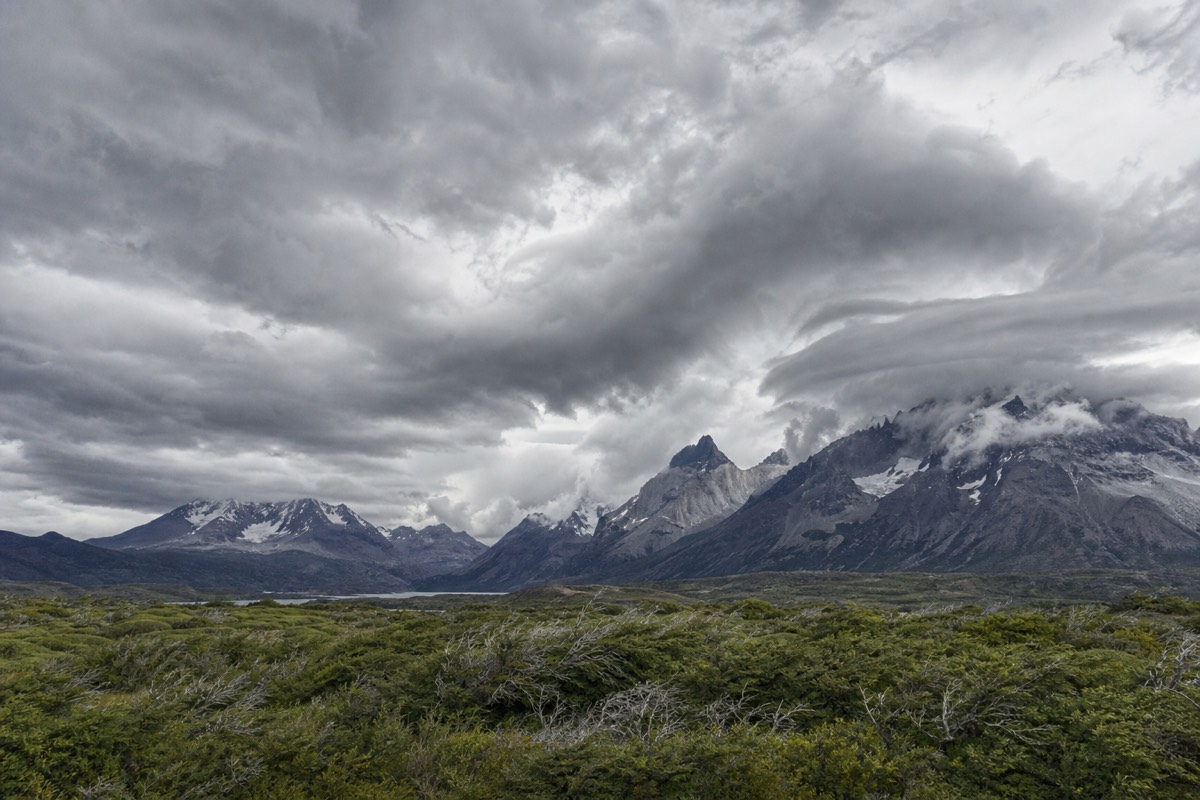
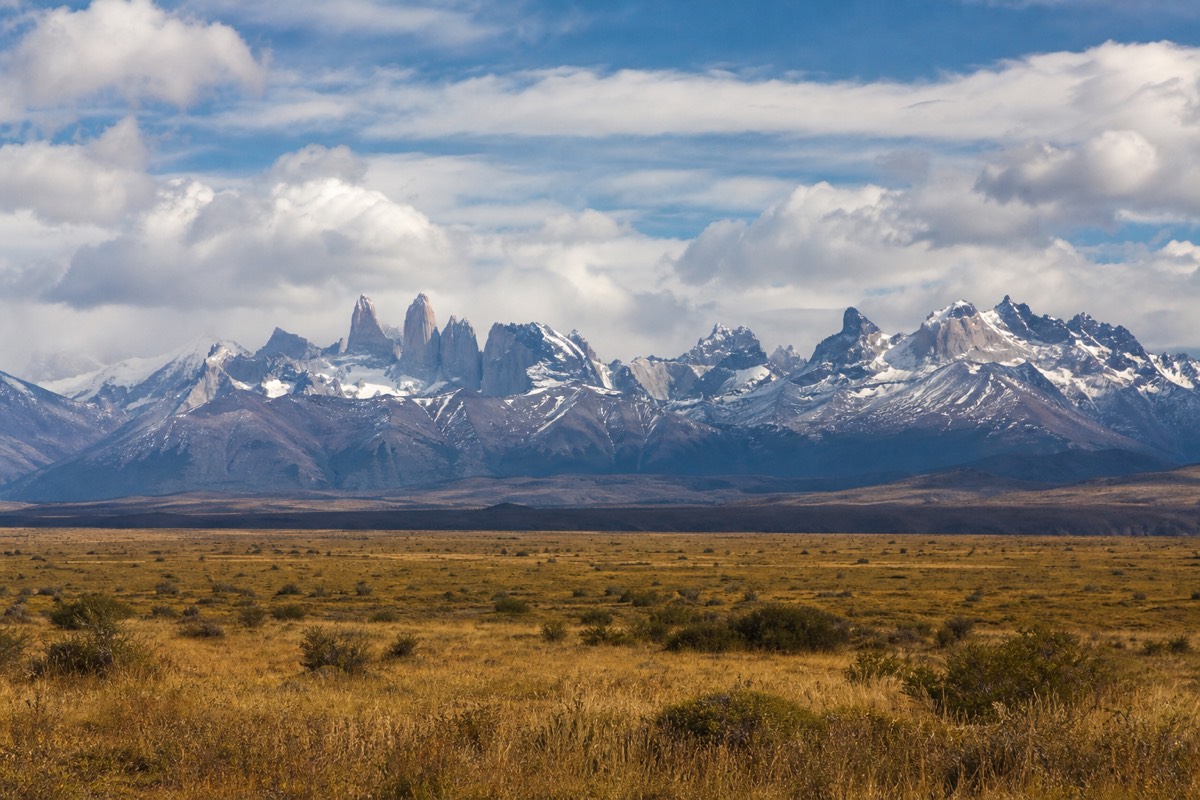
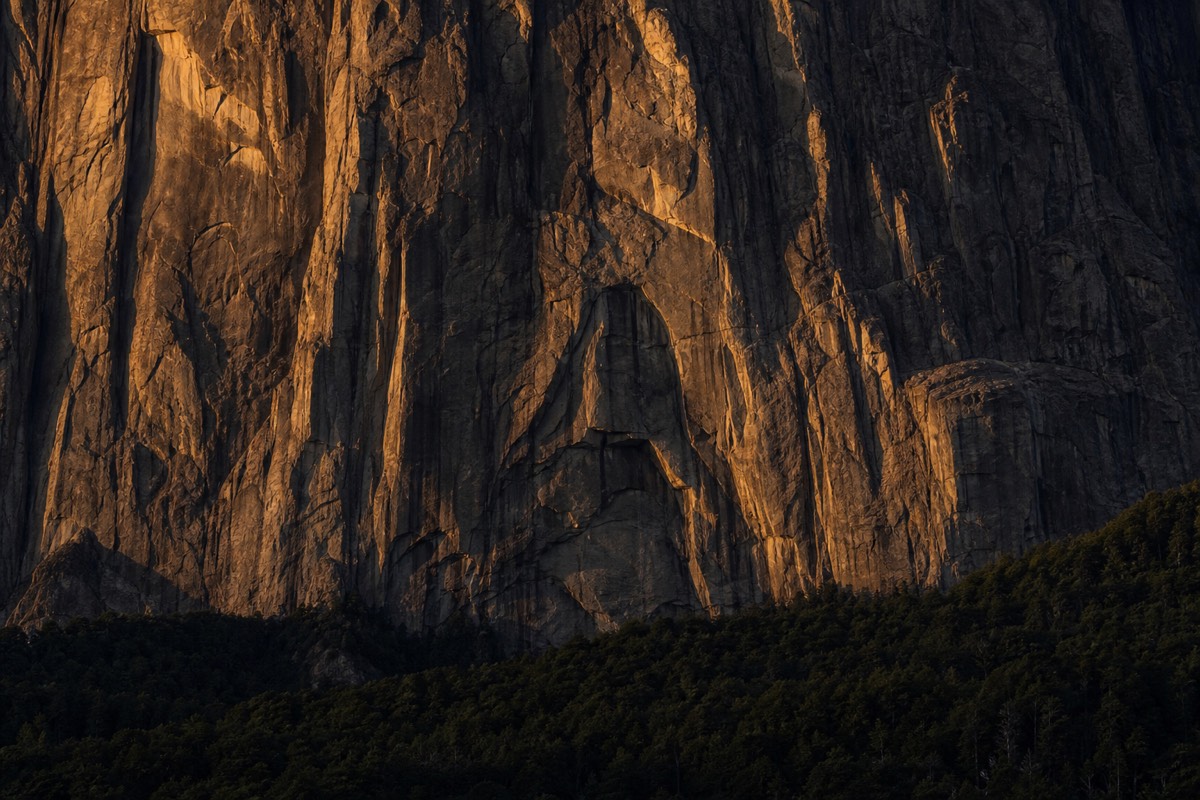
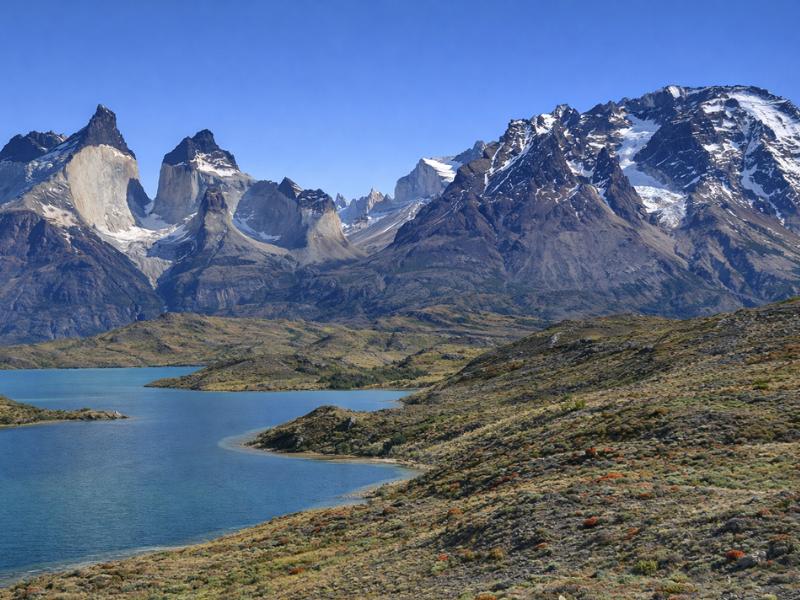
Torres del Paine gives you two separate granite events: the three vertical towers above a glacial lagoon at the end of a 21 km walk, and the Cuernos del Paine, the dark-capped horns that rise straight out of Lake Nordenskjöld and are visible from the road. El Chaltén gives you Fitz Roy and Cerro Torre, and gives them to you from the village street on a clear morning.
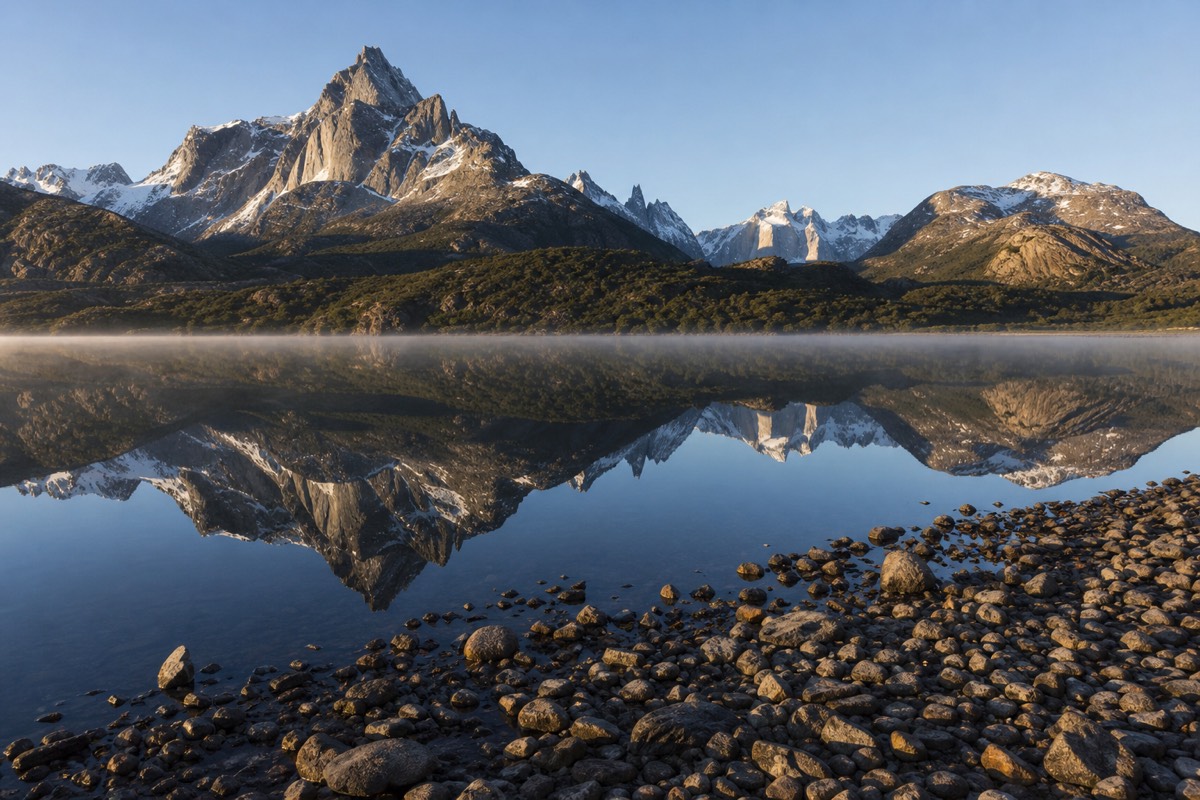
The Chilean massif is more varied. Because the park wraps around the mountains rather than sitting at their foot, you see the range from the steppe, from the lakes, from the water and from inside the valleys, and the Cuernos in particular photograph well from a car park. Alpenglow on the towers lasts around twenty minutes after sunrise and requires you to be at the mirador for it, which in practice means sleeping at Chileno or Campamento Torres.
Fitz Roy is a single overwhelming object rather than a set of them, and its advantage is proximity. You do not need a 21 km day to be underneath it in a meaningful way, and the skyline is part of daily life in the village. Cerro Torre is the thinner, more famous-to-climbers spire alongside it and is more often in cloud.
Neither is a reliable view. Cloud sits on both ranges for large parts of any given week, and the sensible planning response is the same on both sides of the border: give yourself more days than you think you need, and treat a clear morning as the thing you drop everything for. If your priority is standing under the towers specifically, the ranked day hikes guide sets out how much walking that costs.
What does it cost to walk in each one?
Torres del Paine charges a foreign adult 34,000 Chilean pesos, around $36, for a single day, or 48,500 CLP, around $51, for a pass valid up to ten consecutive days. Children under 12 are free. El Chaltén's classic day trails start from the village with no gate to pass through, which makes the pure hiking cost of a day there effectively nothing beyond food.
The multi-day Chilean ticket pays for itself the moment you stay a second night, which almost nobody works out before buying. Both tickets are date locked and non refundable except when the park itself closes, so a weather day you spend in Puerto Natales is money gone. CONAF applied a 4.9% inflation adjustment for January to April 2026 and has postponed its new differentiated tariff system to 1 May 2026, so treat every figure here as current rather than permanent and check the official ticketing portal before you travel.
The entrance fee is the small part of the difference. The real cost gap is in the beds. On the W, dorm beds are published between roughly $46 and $114 per person depending on season and sector, own-tent campsites at roughly $11 to $14, and equipped camping on the Las Torres side at $30 to $50, with Serón running $40 to $90 in high season. Meals in the refugios cluster around $25 for breakfast, $20 to $50 for a box lunch and $35 to $70 for dinner. Sleeping in El Chaltén means sleeping in a village with normal village accommodation, and day-hiking from a village is structurally cheaper than sleeping on a trail run by concessionaires.
Self-guided W trekkers report all-in costs published between roughly $600 and $1,500 depending on camping versus refugio beds, and guided packages run $1,700 to $3,500 and up. Full detail sits in the tickets and fees breakdown.
Recommended tours by season
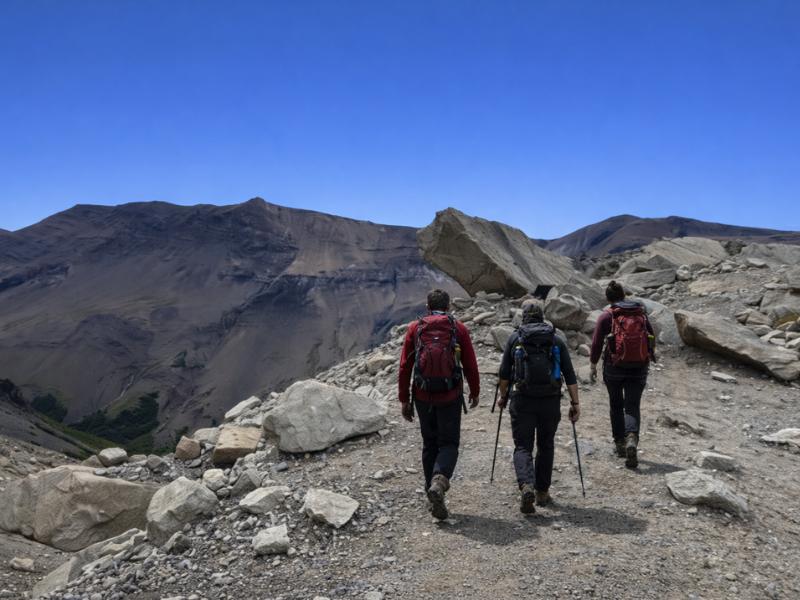
Torres del Paine Base Torres Trekking Day Trip from Puerto Natales
The 21 km towers walk as a day trip from Puerto Natales. Easier to finish in the months with long daylight.
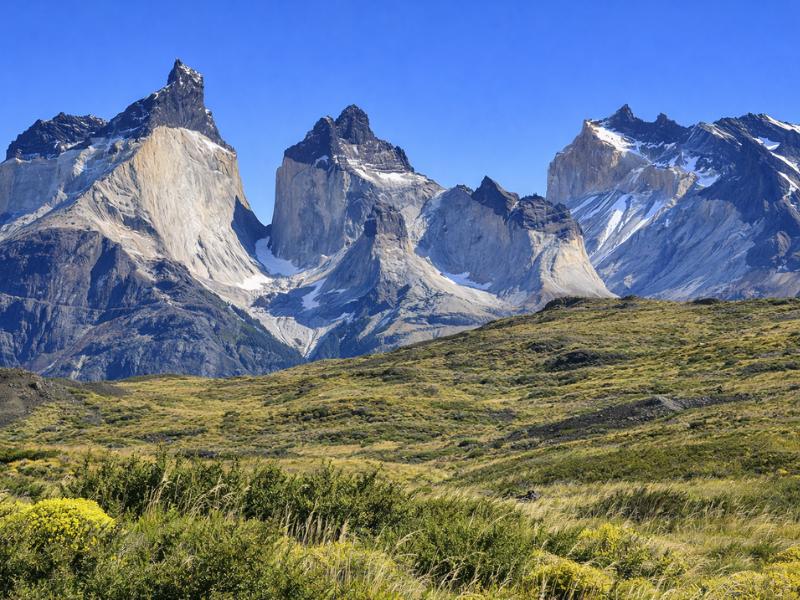
Torres del Paine Full-Day Adventure Tour from Puerto Natales
A guided park day with pickup in Puerto Natales. Useful in January and February when you want the massif without a refugio booking.
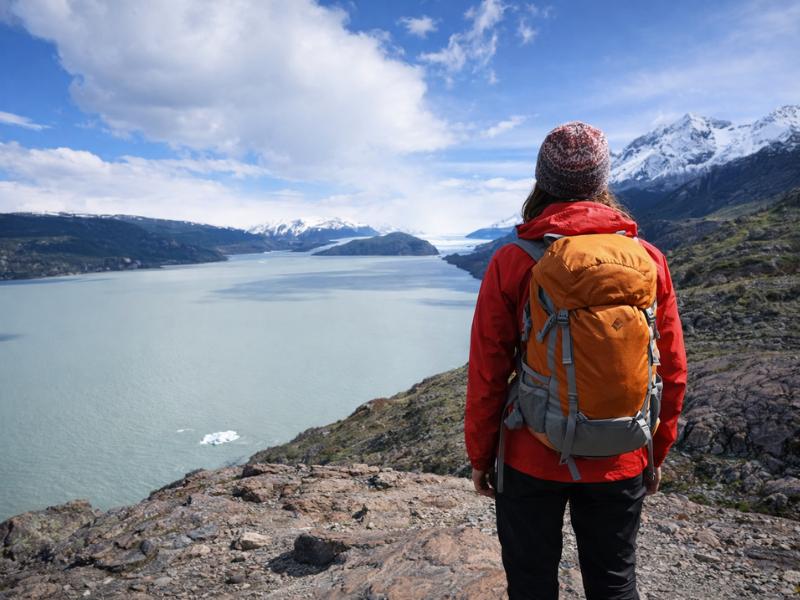
5-Day Torres del Paine W Trek – Guided Patagonia Adventure
A guided W with the concessionaire vouchers and QR check-ins handled for you. December and January dates go first.
4-Day Torres del Paine Experience – Departing Puerto Natales
Hotel nights rather than refugio beds, with park entry and transfers bundled. A fit for the cooler March and April weeks.
| Cost item, Torres del Paine | Published figure |
|---|---|
| Park entry, foreign adult, 1 day | 34,000 CLP, about $36 |
| Park entry, foreign adult, up to 10 days | 48,500 CLP, about $51 |
| Children under 12 | Free |
| Catamaran across Lago Pehoé | About 26,000 CLP, $45 one way |
| Laguna Amarga shuttle, cash only | 4,000 to 4,500 CLP |
| Refugio dorm bed | $46 to $114 per person |
| Own-tent campsite | $11 to $14 per person |
| Self-guided W, all in | $600 to $1,500 |
How far ahead do you have to book?
Torres del Paine wants months. The two concessionaires open the next season's calendar around April, Chileno and the popular December and January dates go first, and park entry is a third separate booking. El Chaltén needs almost none of this for day hiking, because there is no bed on a trail to reserve and no gate quota to clear. That gap is the single biggest practical difference between the two.
The Chilean system catches people out because it is not one system. Las Torres Patagonia runs Central, Chileno and Serón. Vertice Patagonia runs Paine Grande, Grey, Dickson and Los Perros. Neither sells the other's beds, and neither sells park entry. A W itinerary therefore needs three separate transactions that all have to agree with each other, and if Chileno is gone your itinerary changes shape rather than your dates. No free CONAF campsites are operating, and they have not reopened for 2025 to 2026, so anyone planning to camp for nothing needs to hear that early.
Day visitors escape almost all of it. A bus ticket, a park ticket and a seat on the full day tour from Puerto Natales can be arranged inside a week in most of the season. That is the closest Torres del Paine gets to El Chaltén's spontaneity.
If you want the trek without doing the three-system dance yourself, the four day experience bundles all park entrance fees, three nights of hotel and every transfer, and the supported five day W handles the vouchers and the QR check-ins for you. How the systems interlock is set out in our refugios and campsites guide.
| What needs booking | Who sells it | How far ahead |
|---|---|---|
| Park entry | pasesparques.cl, CONAF | Before arrival, date locked |
| Central, Chileno, Serón beds | Las Torres Patagonia | Calendar opens around April |
| Paine Grande, Grey, Dickson, Los Perros | Vertice Patagonia | Calendar opens around April |
| Catamaran across Lago Pehoé | Operator timetable, weather dependent | Fixed sailings, wind cancels |
| Day tour from Puerto Natales | Tour operators | Often within a week |
| El Chaltén day hikes | Nobody, trails start in the village | No booking needed |
Which one has the better day hiking?
El Chaltén, and it is not especially close. Its best-known trails leave from the village and return to it, which means a hiker with no car, no bus ticket and no park ticket can walk something excellent on the morning the weather turns good. Torres del Paine's day hiking is real but it is gated behind a 112 km road and a 2 to 3 hour bus.
That said, the Chilean day-hike menu is longer than its reputation suggests. Salto Grande is 1.5 km and 30 minutes. Mirador Condor is 3 km with 200 metres of ascent, about 90 minutes, and gives the whole massif above Lago Pehoé. Mirador Cuernos is 4 km and 150 metres. The Ferrier lookout is 4 km with 300 metres. The Lago Grey beach is 2 km on the flat to stranded icebergs. Laguna Azul runs 19.4 km with 470 metres, and the Pingo valley 21 km with 750 metres.
And then there is Base Torres, which is 21 km round trip with 1,041 metres of ascent and takes 8 to 10 hours, a genuine full day and the single most walked trail in Chilean Patagonia. The last 0.8 km is a moraine boulder field climbing about 200 metres in 45 minutes. Our guided version of that day runs $99, includes Black Diamond poles and an assistant guide, and gets you back to Puerto Natales between 20:00 and 21:00.
| Torres del Paine day hike | Distance | Ascent | Time |
|---|---|---|---|
| Salto Grande | 1.5 km | Minimal | 30 minutes |
| Lago Grey beach | 2 km | Flat | Under an hour |
| Mirador Condor | 3 km | 200 m | About 90 minutes |
| Mirador Cuernos | 4 km | 150 m | About 90 minutes |
| Ferrier lookout | 4 km | 300 m | About 2 hours |
| Laguna Azul | 19.4 km | 470 m | Full day |
| Pingo valley | 21 km | 750 m | Full day |
| Base Torres | 21 km | 1,041 m | 8 to 10 hours |
None of those need a village trailhead the way El Chaltén's do, but every one of them needs the 112 km road first. That single fact is the whole trade-off in one table.
The fair summary is that El Chaltén wins on access and Torres del Paine wins on variety. Nowhere in El Chaltén gives you a glacier beach, a guanaco steppe and a granite lagoon in the same park.
Which one has the better multi-day trek?
Torres del Paine, clearly. The W runs about 80 km over 4 to 5 days with published totals ranging from 60 to 85 km depending on which side trips are counted, and cumulative ascent published between 2,730 m and 3,480 m. The O Circuit adds the back side for 120 to 136 km over 7 to 9 days with about 4,971 m of ascent and a mandatory counter-clockwise direction.
The W's shape is what makes it work as a first big trek. Three valleys hang off one spine, you sleep in refugios or reserved campsites rather than wild camping, and food can be bought along the way, which keeps the pack manageable. Most packages walk it west to east, taking the catamaran to Paine Grande first and finishing at Base Torres, often at sunrise. East to west puts the hardest day first while legs are fresh.
The O adds Serón, Dickson and Los Perros on the north side and the John Gardner Pass at 1,200 m, which may only be crossed from the Los Perros side and is the most weather-exposed point on either route. Departures from Los Perros are often required by 07:00 and the day typically runs 10 to 12 hours. CONAF closes the pass on conditions and listed the circuit as closed until at least 31 October 2026. We do not sell the O Circuit, and our O Circuit guide exists to tell you honestly what it involves rather than to book it.
El Chaltén's multi-day options exist but they are not the reason people go there. The village's reputation was built on day walks, and we are not going to quote route distances for Argentine traverses we cannot source. If a multi-day trek is the centre of your trip, that decision points west, and the full W trek guide is where to start.
Weather and wind: is one of them worse?
Neither has an edge worth planning around. Both sit in the same westerly belt and both get frontal systems that turn a still morning into a sideways afternoon. The Puerto Natales record shows average wind peaking at 37 kph in November and bottoming at 28.5 kph in May, and the park is windier than the town. Everyday summer gusts of 60 to 100 kph are what hikers meet.
Regional sources have reported gusts in the park up to about 193 kph. That is an extreme rather than a normal, but it explains why the catamaran across Lago Pehoé gets cancelled and why the Grey Glacier sailings do too. Wind, not rain, is what cancels things in Chilean Patagonia.
The seasonal pattern is worth internalising because it applies broadly to both sides of the border. December is the wettest month at 155 mm and the longest at about 17 hours of daylight. September is the driest at 103 mm but short and cold, with a 5.4 C average high. January and February are the warm, busy, windy months. March and April cool down, quieten and bring autumn colour to the lenga forest, and the wind eases through to May.
One genuinely local detail: the western side of Torres del Paine is significantly wetter than the eastern steppe, so Grey can be under rain while Laguna Amarga is dry. That gives a Chilean visitor an option an El Chaltén visitor does not have, which is to move sector rather than write off the day. Timing is set out fully in the best time to visit guide.
How do you do both in one trip, and how long does that take?
Ten to fourteen days is the realistic window for both, and twelve is the comfortable number. That buys three or four days around El Calafate and El Chaltén, a full travel day across the border, four or five days in and around Torres del Paine, and two spare days for weather, which is the part people cut and then regret.
The usual shape runs east to west. Fly into El Calafate, see Perito Moreno, bus up to El Chaltén for the day hikes, come back to El Calafate, then take the bus to Puerto Natales, about 6 hours plus the Cerro Castillo crossing at roughly $40 to $50. From Puerto Natales you have the park 112 km up the road and you fly home from Punta Arenas, 250 km south.
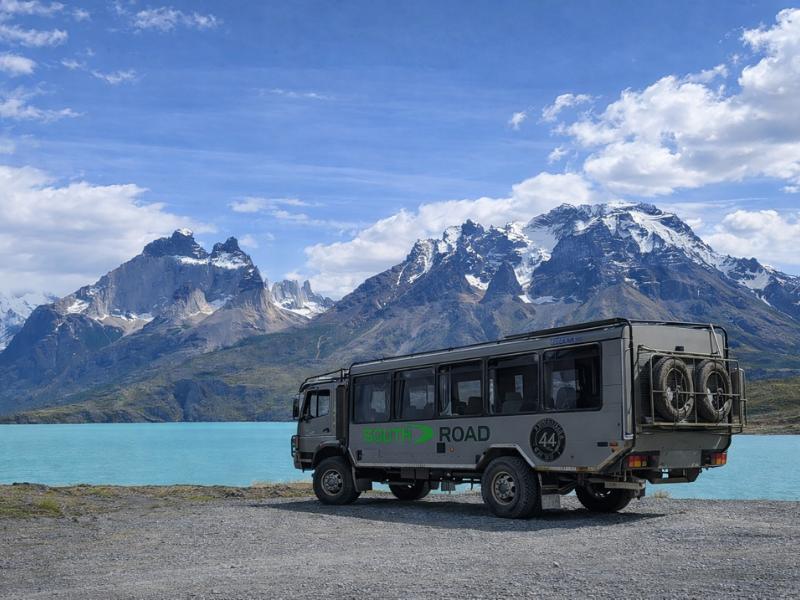
You can also compress the Chilean side to a single day. The overland 4x4 expedition from El Calafate does the whole thing as a 14 to 16 hour day using an unpaved shortcut, with hotel pickup in El Calafate, a bilingual guide, a box lunch and help with the customs paperwork, stopping at Lago Pehoé, Lake Nordenskjöld and Salto Grande. Park entry and the digital affidavit Chile requires are not included. It is a long day and it is the only way to see the park from Argentina without relocating.
Two spare days is not padding. Cloud on the towers, a cancelled catamaran and a wind-bound glacier sailing can all happen inside the same week, and a trip with no slack simply loses those sights. If you want the two-country question answered from the other direction, we have a piece on choosing between Chilean and Argentine Patagonia.
Who should pick Torres del Paine, and who should pick El Chaltén?
Pick Torres del Paine if you want a multi-day trek with beds and meals on it, glaciers reachable by boat, wildlife on open steppe, and a park big enough to fill five days. Pick El Chaltén if you have limited time, a small budget, no appetite for booking systems, or you want to keep your plans loose and walk on the good-weather morning.
There is a third category worth naming. Travellers with mobility limits, small children or a genuine dislike of long days do better in Torres del Paine than they expect, because so much of it is visible from a road and a vehicle. Children under 12 enter the park free, the Salto Grande walk is 1.5 km on the flat, and a full day scenic tour puts the Cuernos, a waterfall, flamingos at Laguna Amarga and a cave in front of you without a single hard hour on foot. That is a harder day to build in El Chaltén, where the good stuff is at the end of trails.
Photographers split differently again. Torres del Paine offers more compositions, more water, more foreground and more wildlife. El Chaltén offers one of the most recognisable mountain profiles on earth from a spot you can walk to in slippers. We cover the Chilean side of that in the photography guide.
If you are still undecided and you only get one, take Torres del Paine, because it is the harder one to bolt onto a future trip and because it contains more different kinds of day. Every option we sell there, from a $99 trekking day to a supported W, sits on our guided trips into the park.
| If you are | Pick | Because |
|---|---|---|
| Doing your first multi-day trek | Torres del Paine | The W has beds, meals and a clear shape |
| Travelling on a tight budget | El Chaltén | No entrance fee on the classic day trails |
| Short on planning time | El Chaltén | Torres del Paine beds open around April |
| Travelling with young children | Torres del Paine | Under 12s free, most sights road accessible |
| Chasing glaciers | Torres del Paine | Grey by boat, beach or trail |
| Chasing wildlife | Torres del Paine | Guanaco steppe, condors, the densest pumas |
| Coming from El Calafate for one day | Either, via the 4x4 day | 14 to 16 hours gets you the Chilean highlights |
What we will not put a number on for El Chaltén
Trail distances, ascent figures, walking times, bus fares, accommodation rates and visitor counts for El Chaltén are all absent from this article on purpose. We hold verified, sourced figures for Torres del Paine and we do not hold equivalents for the Argentine side. Rather than borrow numbers from elsewhere and present them as ours, we have kept that half of the comparison structural.
What that means in practice: everything above about El Chaltén describes how the place is organised, not how far you walk in it. Trailheads leaving from the village, no ticket gate on the classic day walks, El Calafate as the transport hub, granite as the draw, day hiking as the strength. Those are structural facts about how the destination functions and they are what the comparison actually turns on.
If you need Argentine trail numbers, take them from the Argentine park administration directly rather than from a Chilean tour site. We would rather be visibly incomplete than quietly wrong, and the same principle governs the Chilean figures here: where sources disagree, such as the W's 60 to 85 km range or the Británico approach at 7.5 to 12 km, we print the range rather than pick a number.
For the Torres del Paine side you can check our sources yourself. Park rules, closures and seasonal guide requirements come from CONAF's own park page, and the wider Chilean context from the national tourism board. Route logistics from the Chilean side are in the getting there guide.